
English has many small word pairs that look simple but cause big confusion. “Day off” and “off day” are perfect examples.
They use the same two words — day and off — but the meaning changes completely when we switch the order.
Many English learners mix them up. Some students say, “I have an off day tomorrow,” when they really mean they are not working.
Others say, “Today is my day off, so I played badly,” which sounds strange to native speakers.
The problem happens because both phrases talk about days, rest, and performance. The meanings feel close. But in real English, they are used in very different situations.
Understanding the difference is very important in daily life. You will hear these phrases at work, school, sports, and casual conversations. Your boss, friends, and coworkers use them all the time.
After reading this guide, you will clearly know:
- what each phrase means
- when to use it
- how the grammar works
- how native speakers say it naturally
- and how to avoid common mistakes
By the end, you will feel comfortable using both expressions without stopping to think.
What Does “Day Off” Mean?
Simple definition
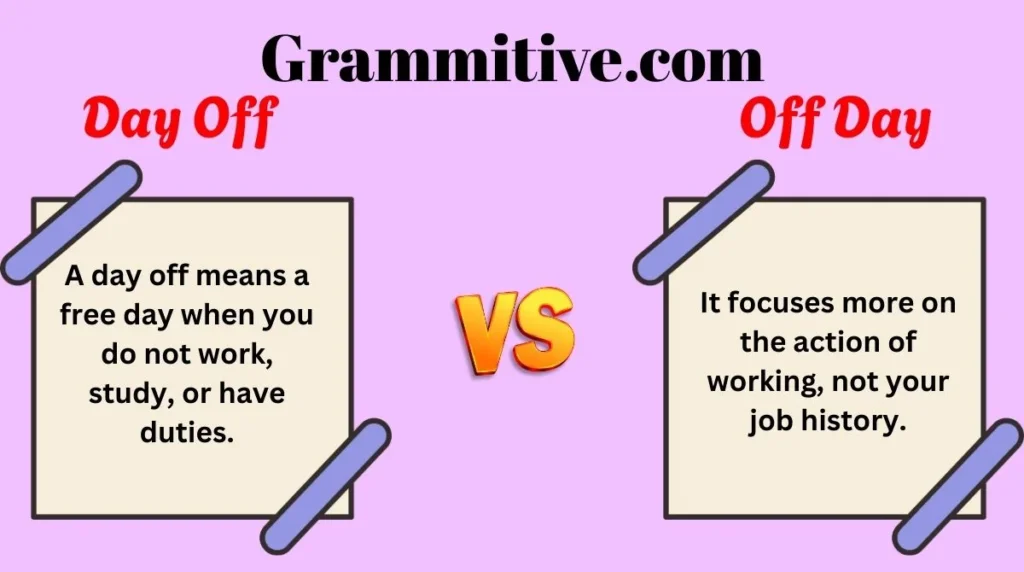
A day off means a free day when you do not work, study, or have duties.
It is a rest day.
You relax. You sleep more. You do fun things.
When to use it
Use “day off” when:
- you are not working
- you are not going to school
- you take a break from responsibilities
- you are free for personal time
It is very common in jobs and schedules.
Grammar rule
“Day off” is a noun phrase.
We often use:
- a day off
- my day off
- take a day off
- have a day off
- get a day off
Structure:
subject + have/take/get + a day off
Example sentences (6–8)
- I’m tired. I need a day off.
- She took a day off to visit her parents.
- Tomorrow is my day off, so I’m going hiking.
- We don’t have a day off this week.
- He asked his boss for a day off.
- Sundays are my day off.
- Let’s meet on my day off.
- The doctor told her to take a day off and rest.
Common learner confusion
Many students think “day off” means “lazy day” or “bad day.” But it doesn’t.
It simply means no work or duties.
You might still have a busy day. For example:
“I have a day off, but I need to clean the house.”
So remember: it’s about schedule, not mood or performance.
What Does “Off Day” Mean?
Simple definition
An off day means a day when you don’t feel normal, don’t perform well, or something feels wrong.
Your energy is low. Your focus is poor. Things don’t go smoothly.
It’s about performance or mood, not your schedule.
When to use it
Use “off day” when:
- you feel tired or strange
- you make more mistakes than usual
- you play badly in sports
- your brain feels slow
- nothing goes right
Grammar rule
“Off day” is also a noun phrase, but the meaning is different.
Common patterns:
- have an off day
- today is an off day
- it’s just an off day
Structure:
subject + have/is + an off day
Notice we usually use an, not a, because “off” starts with a vowel sound.
Example sentences (6–8)
- I couldn’t focus at work today. It was an off day.
- The player had an off day and missed many shots.
- Sorry for the mistakes. I’m having an off day.
- She usually cooks well, but today is an off day.
- Don’t worry. Everyone has off days sometimes.
- My brain feels slow. Definitely an off day.
- The team lost because several players had off days.
- I’m not sick, just a little off today.
Common learner confusion
Some learners think “off day” means holiday or vacation. That is incorrect.
It does not mean free time.
You might still go to work on an off day. You just don’t perform well.
So remember: it’s about how you feel or perform, not whether you work.
Difference Between Day Off and Off Day (Detailed)
Although the words look almost the same, the meanings are very different.
The order of words completely changes the idea.
Quick comparison table
| Feature | Day Off | Off Day |
|---|---|---|
| Meaning | Free from work/study | Bad or low-performance day |
| Focus | Schedule | Mood/performance |
| Type | Rest time | Mental/physical state |
| Example | I have a day off | I’m having an off day |
| Work? | No | Yes, usually |
| Feeling | Relaxed | Tired/slow/strange |
Usage difference
If you stay home because you don’t work → day off
If you go to work but feel tired and make mistakes → off day
Grammar logic
“Day off” = day + off (off from work)
Think: off from something
“Off day” = off + day (a day that feels off)
Think: not normal
Sentence structure difference
Day off:
- take a day off
- have a day off
- get a day off
Off day:
- have an off day
- today is an off day
We do not say:
❌ take an off day
❌ get an off day
Meaning comparison
Imagine two situations:
Situation 1:
You sleep late, watch movies, eat snacks, and don’t work.
→ day off
Situation 2:
You go to work but forget things, feel tired, and make mistakes.
→ off day
Big difference, right?
Grammar Rules You Must Remember
Rule #1: “Day off” relates to work or duty
Correct: I took a day off from work.
Wrong: I took an off day from work.
Rule #2: Use “an” before “off day”
Correct: I’m having an off day.
Wrong: I’m having a off day.
Because “off” starts with a vowel sound.
Rule #3: Don’t use “take” with off day
Correct: I had an off day.
Wrong: I took an off day.
Rule #4: “Day off” often follows possessives
Correct: Today is my day off.
Correct: Monday is her day off.
This sounds very natural in English.
Common Mistakes Students Make
Why mistakes happen
The words look almost the same.
Learners translate from their native language.
They guess the meaning based on logic.
But English doesn’t always follow logic.
Wrong vs correct examples
❌ I’m tired. I need an off day.
✔ I’m tired. I need a day off.
❌ Tomorrow is my off day from work.
✔ Tomorrow is my day off.
❌ I took an off day yesterday.
✔ I had an off day yesterday.
❌ I have a day off, so I played badly.
✔ I had an off day, so I played badly.
Easy correction tips
Ask yourself:
- Am I talking about free time? → day off
- Am I talking about bad performance? → off day
This simple question fixes most mistakes.
Easy Trick to Remember the Difference
Here’s a small memory trick students love.
Think about word order
Day OFF → OFF from work
You are off from your job.
So it means rest.
OFF day → day feels OFF
Something is wrong or strange.
So it means bad performance.
Picture it like this:
- Day OFF → beach, sleep, movie
- OFF day → coffee, mistakes, tired face
Your brain will quickly remember the images.
Daily Life Examples (Very Important)
These sound like real spoken English.
- “Hey, are you working tomorrow?”
“Nope, it’s my day off.” - “Why are you home on Tuesday?”
“I took a day off.” - “You look tired today.”
“Yeah, I’m having an off day.” - “The meeting didn’t go well.”
“It’s okay. Everyone has off days.” - “What do you do on your day off?”
“I usually sleep and cook.” - “Sorry I forgot your call.”
“No worries. Maybe you’re just having an off day.” - “She never misses shots.”
“True, but today is an off day.” - “I need a day off. I’m exhausted.”
- “Even great players have off days.”
- “My day off is Sunday, so let’s meet then.”
These are very natural. Native speakers say them every day.
Practice Section
Choose the correct answer: day off or off day
- I’m not working tomorrow. It’s my ______.
- I can’t focus today. I’m having an ______.
- She took a ______ to travel.
- The singer had an ______ and forgot the lyrics.
- We finally got a ______ after two weeks.
Answers
- day off
- off day
- day off
- off day
- day off
FAQs
What is the difference between day off and off day?
A day off means you don’t work or study. It’s a free day.
An off day means you feel tired or perform badly. You may still work.
One is about schedule. The other is about performance.
Can we use “off day” for vacation?
No. That sounds unnatural.
For vacation or holiday, use “day off.”
“Off day” only talks about mood or ability.
Is “day off” formal or informal?
It’s neutral and very common.
You can use it in casual speech or professional emails.
For example: “I’d like to request a day off.”
Can I say “take an off day”?
No. Native speakers don’t say that.
Use “have an off day” instead.
“Take” is used with “day off,” not “off day.”
Which one is more common in daily English?
Both are common but used in different situations.
Workers often say “day off.”
Athletes, students, and employees often say “off day.”
Do both phrases work as nouns?
Yes. Both are noun phrases.
We use them with verbs like have, take, or get.
But the verbs change depending on the phrase.
Final Conclusion
Small word changes can completely change meaning in English, and “day off” and “off day” are perfect examples.
They look almost identical, but they describe two very different ideas. One gives you rest and freedom from work. The other describes a day when your mind or body just doesn’t cooperate.
Once you connect “day off” with free time and “off day” with poor performance, everything becomes simple.
You’ll start noticing these phrases in movies, offices, sports, and daily conversations. And soon, you won’t even have to think before using them correctly.
Practice by making your own sentences. Talk about your last day off. Then describe your last off day. Real-life examples help your brain remember faster.
Language learning becomes easier when you understand the logic behind words. Keep going, keep practicing, and these confusing pairs won’t feel confusing anymore.

I am Lucas Bennett, a digital content creator passionate about social media trends and online growth strategies.
I share practical insights and guides to help users better understand and navigate the digital world.