

Email is part of daily life now. We send messages at work, school, and even at home. But small English phrases inside emails often confuse learners. Two common phrases are “copy on” and “copy in.”
Many students ask the same question:
“Teacher, which one is correct?”
“Are they the same?”
“Why do native speakers use both?”
The problem is simple. Both phrases look almost identical. Both talk about adding someone to an email. And both seem correct in conversation. So learners feel unsure.
If you write the wrong one in a formal email, it may sound unnatural or less professional. In business English, small mistakes can change how people see you. That’s why this topic matters more than it seems.
After reading this full guide, everything will feel easy. You will clearly understand:
- what copy on means
- what copy in means
- how they are different
- which one native speakers prefer
- and how to use them correctly in real emails
The explanations are simple and practical, like a friendly class lesson. By the end, you’ll feel confident writing emails without stopping to think twice.
What Does “Copy On” Mean?
Simple definition
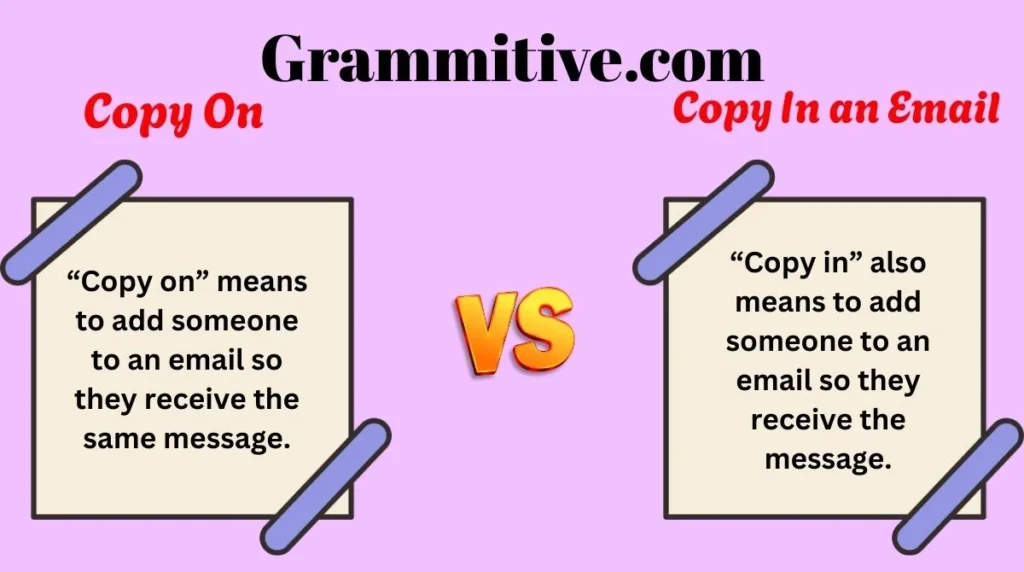
“Copy on” means to add someone to an email so they receive the same message.
It usually refers to putting their address in the CC (carbon copy) field.
When you copy someone on an email, they are not the main person. They just get the message for information.
When to use it
Use copy on when:
- someone needs to know what is happening
- they don’t need to reply
- they are not the main receiver
- you want to keep them informed
It’s common in office English and business communication.
Grammar rule
The structure is:
copy + person + on + email/message
Examples:
- copy me on the email
- copy her on the report
- copy them on the message
Notice: on comes after the person.
Example sentences
- Please copy me on the email.
- Can you copy the manager on this message?
- I copied John on the report yesterday.
- Don’t forget to copy HR on the complaint.
- She copied her boss on the update.
- Copy the team on all future emails.
- He wasn’t copied on the message.
- Always copy me on client emails.
Common learner confusion
Students often think on sounds strange. They ask:
“Why on? Why not in?”
Good question.
The word on here means attached to or included with. It’s like saying:
👉 “Put my name on this email list.”
So the idea is: your name sits on the message.
What Does “Copy In” Mean?
Simple definition
“Copy in” also means to add someone to an email so they receive the message.
Yes — the meaning is almost the same.
That’s why many people feel confused.
When to use it
Use copy in when:
- adding someone to the CC field
- including someone in the conversation
- speaking in British English (very common there)
It’s a little more informal and conversational than “copy on.”
Grammar rule
Structure:
copy + person + in + email/message
Examples:
- copy me in
- copy her in the email
- copy them in the reply
Example sentences
- Please copy me in the email.
- Copy Sarah in so she knows the plan.
- He copied me in on the message.
- Don’t forget to copy the teacher in.
- Can you copy Tom in this thread?
- She copied the team in yesterday.
- I wasn’t copied in.
- Copy finance in for safety.
Common learner confusion
Many learners think copy in means “inside something physically.” That feels strange.
But here, in means inside the email conversation.
So imagine a group chat. When someone adds you, you are now in the discussion.
That’s the idea.
Difference Between Copy On and Copy In (Detailed)
Now comes the big question:
If both mean the same thing… which one should you use?
The answer depends on style, region, and tone.
Quick comparison table
| Feature | Copy On | Copy In |
|---|---|---|
| Meaning | Add someone to CC | Add someone to CC |
| Common in | American English | British English |
| Tone | Slightly formal | Slightly casual |
| Focus idea | Attached to email | Inside conversation |
| Business emails | Very common | Also common |
| Grammar pattern | copy someone on | copy someone in |
Usage difference
In real life, both are correct.
But:
- Americans say copy me on more often
- British speakers say copy me in more often
If you work in an international company, you’ll hear both.
Nobody will think you are wrong. Still, using the common form for your region sounds more natural.
Grammar logic
Think of the meaning of each preposition.
On = attached to a message
In = included inside a group
Both ideas make sense for email.
That’s why English allows both.
Sentence structure difference
Copy on:
- Copy me on the email.
Copy in:
- Copy me in the email.
Only the preposition changes. Everything else stays the same.
Meaning comparison
There is almost no meaning difference. It’s more about feeling.
- “Copy me on” feels professional and direct
- “Copy me in” feels friendly and conversational
In formal business writing, many teachers suggest copy on. But both are acceptable.
Grammar Rules You Must Remember
Rule #1: Use “copy + person + on/in”
Correct:
- Copy me on the email.
- Copy her in the message.
Wrong:
- Copy on me
- Copy in me
The person comes first.
Rule #2: Use after requests
Often used with please, can you, don’t forget
Example:
- Please copy me on the report.
Rule #3: Works in past tense too
Example:
- She copied me in yesterday.
- They copied the boss on the email.
Just change the verb tense.
Rule #4: Don’t use with “to”
Wrong:
- Copy me to the email ❌
Correct:
- Copy me on the email ✅
“To” is used for the main receiver, not CC.

Common Mistakes Students Make
Why mistakes happen
The problem is:
- prepositions are confusing
- many languages don’t use this structure
- learners translate directly
So errors are normal.
Wrong vs correct examples
❌ Copy me to the email
✅ Copy me on the email
❌ Please copy in me
✅ Please copy me in
❌ Add me at the email
✅ Copy me on the email
❌ Include me to CC
✅ Copy me in CC
Easy correction tips
- Always say the person first
- Then use on or in
- Never use to
Simple formula:
👉 copy + name + on/in
Easy Trick to Remember the Difference
Here’s a small memory trick students love.
Think like this:
ON = stuck ON the message
Your name is attached on top.
IN = inside the group
You are inside the conversation.
So:
- paperwork style → ON
- group chat feeling → IN
If you can’t decide, don’t worry. Both are correct. Just choose one and stay consistent.
Daily Life Examples (Very Important)
These sound like real office or school conversations.
- “Hey, copy me on that email, please.”
- “Can you copy the manager in?”
- “I forgot to copy you in. Sorry!”
- “Please copy HR on all complaints.”
- “She copied me on the client message.”
- “Don’t copy everyone in. It’s not necessary.”
- “Can you copy the whole team on this?”
- “He wasn’t copied in, so he didn’t know.”
- “Next time, copy me on updates.”
- “I’ll copy you in when I reply.”
These sentences are short and natural. Perfect for everyday English.
Practice Section
Choose on or in.
- Please copy me ___ the email.
- She copied the boss ___ yesterday.
- Can you copy Tom ___ this thread?
- Don’t forget to copy me ___ the report.
- He wasn’t copied ___ the message.
Answers
- on / in (both correct)
- on / in
- in
- on
- in
FAQs
What is the difference between copy on and copy in an email?
Both mean adding someone to receive the same email. The difference is mostly style. “Copy on” is common in American English. “Copy in” is common in British English.
Which one is more correct?
Both are correct grammar. Neither is wrong. Choose the one that sounds natural in your workplace or country.
Can we use copy on or copy in in questions?
Yes. You can ask: “Can you copy me on this?” or “Could you copy me in?” Both sound natural and polite.
Is copy on more formal?
Yes, slightly. Many people feel “copy on” sounds more business-like, while “copy in” feels more conversational.
Can I use these phrases in spoken English?
Yes. People use them all the time in offices and meetings. They are not only for writing.
Do they always mean CC?
Almost always, yes. They usually refer to the CC field, not the main “To” field.
Final Conclusion
Small grammar points can feel big when you write professional emails. “Copy on” and “copy in” are perfect examples.
They look confusing at first, but the truth is simple. Both mean adding someone to receive the message.
The only real difference is style and region. American speakers often prefer “copy on.” British speakers often say “copy in.” Grammar rules stay the same.
Once you remember the structure — copy + person + on/in — everything becomes easy. No more guessing. No more worry.
Practice using these phrases in your daily emails. Try saying them out loud too. After a few days, they will feel natural, just like any other English expression.
Clear communication builds confidence. And confident English always sounds better.

I am Lucas Bennett, a digital content creator passionate about social media trends and online growth strategies.
I share practical insights and guides to help users better understand and navigate the digital world.