
English has many word pairs that look almost the same but feel slightly different. These small differences often confuse learners. One such pair is “continuing success” and “continued success.”
At first glance, both phrases seem to mean the same thing. Both talk about success that goes on. So naturally, many students think, “Aren’t they identical?”
But in real English, they are not exactly the same. Native speakers choose one or the other depending on the situation, the time, and the feeling they want to express.
You might hear someone say:
“Wishing you continued success.”
But rarely:
“Wishing you continuing success.”
Why is that?
This tiny change in word form changes the grammar and the meaning. If you use the wrong one, your sentence may sound strange or unnatural, even if it’s not completely wrong.
Understanding this difference helps you:
- speak more naturally
- write better emails and messages
- sound professional in school or work
- avoid common grammar mistakes
By the end, you will clearly know when to use each phrase, how they work grammatically, and how to choose the correct one without thinking too hard.
What Does “Continuing” Mean?
Simple definition
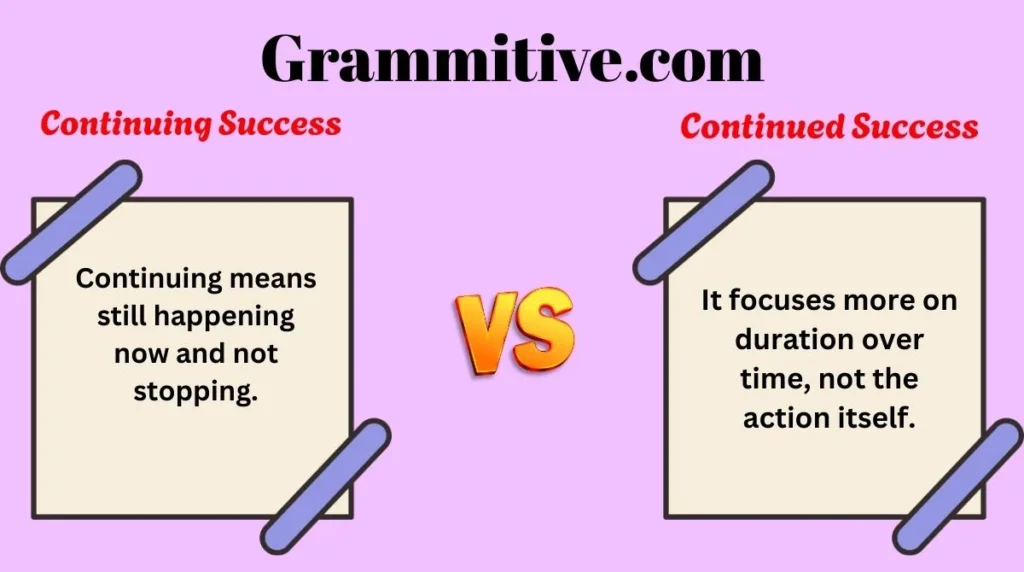
Continuing means still happening now and not stopping.
It shows an action that is in progress or going on at this moment.
Think of it like this:
👉 The action is alive right now.
When to use it
Use continuing when:
- something is happening at present
- the action has not stopped
- you want to focus on the process
It often describes activities, events, or situations that are actively moving forward.
Grammar rule
“Continuing” is the -ing form of the verb continue.
It works as:
- an adjective (continuing problems)
- part of a verb phrase (is continuing)
- a participle describing an ongoing state
The -ing form usually suggests action in progress.
Example sentences
- The rain is continuing all night.
- She has continuing health problems.
- We are continuing the meeting after lunch.
- There is continuing tension between the two teams.
- The company is continuing its research.
- They showed continuing support for the project.
- The noise is continuing, and I can’t sleep.
- He is continuing his studies abroad.
Common learner confusion
Many learners think:
continuing = long time
But that’s not exactly right.
It means happening now, not just lasting a long time.
For example:
❌ continuing success for 10 years
This sounds odd.
Because success isn’t an action happening right now like rain or talking. It’s more like a result or state.
So “continuing” doesn’t always fit well with abstract nouns like success.
What Does “Continued” Mean?
Simple definition
Continued means something started in the past and still exists or carries on.
It focuses more on duration over time, not the action itself.
Think of it like this:
👉 It began earlier and has not stopped.
When to use it
Use continued when:
- something lasted over time
- something keeps going
- you talk about long-term situations
- you make polite wishes or formal expressions
It often sounds more natural with:
- success
- support
- growth
- cooperation
- effort
Grammar rule
“Continued” is the past participle of continue.
It acts as an adjective.
It describes a state that has lasted or persisted.
Unlike “continuing,” it doesn’t feel active. It feels more stable and lasting.
Example sentences
- We thank you for your continued support.
- She enjoyed continued success in her career.
- The team showed continued improvement.
- There was continued pressure from the media.
- He received continued help from his family.
- The company experienced continued growth.
- We hope for continued peace.
- Thank you for your continued patience.
Notice something?
These sound very natural and professional.
That’s because continued + abstract nouns is very common in English.
Common learner confusion
Students sometimes think:
“continued” means finished
Because it looks like past tense.
But here it doesn’t mean finished.
It means:
👉 “still happening over time”
So don’t let the past form trick you.
Difference Between Continuing and Continued (Detailed)
Now comes the most important part.
Both words come from continue, but they feel different in time and usage.
Quick comparison table
| Feature | Continuing | Continued |
|---|---|---|
| Form | -ing (present participle) | past participle |
| Feeling | action in progress | lasting over time |
| Focus | process | duration/result |
| Common with | events, actions | success, support, growth |
| Tone | active | stable, formal |
| Natural with “success”? | rare | very common |
Usage difference
Continuing
→ something actively happening now
Continued
→ something that has lasted and keeps going
Grammar logic
The -ing form suggests movement or activity.
The -ed form suggests condition or state.
Success is not an activity.
You don’t “do” success every second.
It’s a state or result.
That’s why continued success sounds natural, but continuing success sounds awkward.
Sentence structure difference
Continuing:
- continuing problems
- continuing discussion
- continuing work
Continued:
- continued success
- continued support
- continued growth
Notice how abstract nouns usually prefer “continued.”
Meaning comparison
Compare:
👉 The discussion is continuing.
(We are still talking now.)
👉 The company saw continued growth.
(Growth lasted over time.)
See the difference in feeling?
Grammar Rules You Must Remember
Rule #1 – Use “continuing” for actions happening now
The show is continuing after the break.
Rule #2 – Use “continued” for long-lasting states
She enjoyed continued success.
Rule #3 – Abstract nouns usually take “continued”
Correct: continued support
Not natural: continuing support
Rule #4 – Polite/formal expressions use “continued”
We wish you continued happiness.
This is very common in emails and speeches.
Common Mistakes Students Make
Why mistakes happen
The words look almost the same.
Also, many languages don’t have this small difference.
So learners translate directly and guess.
Mistake 1
❌ I wish you continuing success.
✅ I wish you continued success.
Tip: Wishes = usually “continued.”
Mistake 2
❌ The continuing growth lasted 5 years.
✅ The continued growth lasted 5 years.
Tip: Long time = continued.
Mistake 3
❌ We saw continued talking.
✅ We saw continuing talking OR continued discussion.
Tip: Talking is an action → continuing.
Easy correction tips
Ask yourself:
Is it happening now → continuing
Is it lasting over time → continued
Easy Trick to Remember the Difference
Here’s a simple classroom trick.
Think:
ING = happening
ED = established
Or even easier:
👉 continuing = moving
👉 continued = lasting
Imagine a movie.
The movie is continuing (still playing).
But the movie had continued success (it stayed popular for years).
Movement vs result.
This small idea helps a lot.
Daily Life Examples (Very Important)
These are sentences you might hear in real conversations.
- Thanks for your continued support, everyone.
- The meeting is continuing after lunch.
- She has had continued success in business.
- The rain is continuing all day.
- We hope for your continued cooperation.
- The teacher is continuing the lesson.
- The brand enjoyed continued popularity.
- The noise is continuing, and it’s annoying.
- He thanked customers for their continued trust.
- The repairs are continuing tomorrow.
Try reading them aloud. You’ll feel the difference naturally.
Practice Section
Choose the correct word.
Questions
- We wish you ______ success. (continuing / continued)
- The game is ______ after the break.
- Thank you for your ______ support.
- The problems are ______ every day.
- The company saw ______ growth for ten years.
Answers
- continued
- continuing
- continued
- continuing
- continued
FAQs
1. What is the difference between continuing and continued?
“Continuing” shows an action happening now. “Continued” shows something that has lasted over time. The second one is common with success, support, and growth.
2. Which is correct: continuing success or continued success?
“Continued success” is correct and natural. Native speakers almost always use this form.
3. Can we use continuing with success?
It’s not wrong grammatically, but it sounds unnatural. Most speakers avoid it.
4. Is continued more formal?
Yes. It often appears in formal writing, business emails, and speeches.
5. Can continuing be an adjective?
Yes. For example: continuing problems, continuing discussion. It describes something still happening.
6. Why does continued not mean past or finished?
Because it works as an adjective, not a past tense verb. It means something still going on from the past.
Final Conclusion
Small grammar differences can change how natural your English sounds. “Continuing” and “continued” are perfect examples. Both come from the same verb, yet they give different feelings.
Use continuing when an action is happening right now. Think about movement and process. Use continued when something lasts over time, especially with abstract nouns like success, support, growth, or cooperation.
If you remember only one thing, remember this:
Native speakers say continued success, not continuing success.
Read real examples, listen to how people speak, and practice making your own sentences. With time, the choice will feel automatic. Your English will sound smoother and more confident.
Keep practicing, and may you enjoy continued success in your learning journey!

I am Lucas Bennett, a digital content creator passionate about social media trends and online growth strategies.
I share practical insights and guides to help users better understand and navigate the digital world.