

English has many small grammar points that look easy but quietly confuse learners.
One of them is this pair:
continue working
continue to work
At first, they seem the same. Both talk about something that does not stop. Both use the verb continue. And both are used by native speakers every day.
So learners often ask:
“Is there a difference?”
“Which one is correct?”
“Do I need the to?”
“Can I use both?”
Because the meanings are very close, it feels tricky. Some textbooks say “both are fine,” but that answer is not very helpful. Students want clear rules and real examples.
This topic is important in daily English. You will hear these forms at work, at school, in movies, and in conversations like:
- “Please continue working.”
- “He continued to work late.”
- “She continued studying.”
- “They continued to talk.”
If you don’t understand the pattern, you may hesitate when speaking or writing.
By the end of this guide, you will clearly understand:
- when to use continue + -ing
- when to use continue + to + verb
- the small differences in meaning
- easy rules to remember
- common mistakes to avoid
Everything is explained in simple, friendly English — just like a teacher talking to you in class.
What Does “Continue Working” Mean?
Simple definition
Continue working means:
👉 keep doing the same action without stopping.
It uses:
continue + verb-ing (gerund form)
So we focus on an activity that is already happening.
When to use it
Use continue working when:
- the action already started
- it is still happening
- nothing changes
- we simply keep going
It often feels more natural in everyday speech.
Grammar rule
Structure:
continue + verb-ing
Examples:
- continue working
- continue studying
- continue talking
- continue driving
Example sentences
- Please continue working. The boss is coming soon.
- She continued studying even after midnight.
- They continued talking during the movie.
- He continued driving despite the heavy rain.
- The children continued playing outside.
- I continued reading the book on the bus.
- We continued waiting for the train.
- She continued practicing the piano every day.
Common learner confusion
Many students think:
“Do I always need to after continue?”
No. You don’t.
English allows two patterns:
- continue working
- continue to work
Both are correct.
The -ing form simply feels more natural when the action is already happening.
It sounds smooth and conversational.
What Does “Continue to Work” Mean?
Simple definition
Continue to work also means:
👉 keep doing something without stopping.
But it uses the to + base verb (infinitive) form.
When to use it
Use continue to work when:
- you talk about a situation or result
- you describe something more formal
- you talk about facts or general truths
- you want to sound slightly more structured or written
It is very common in formal writing, news, and reports.
Grammar rule
Structure:
continue + to + base verb
Examples:
- continue to work
- continue to study
- continue to grow
- continue to improve
Example sentences
- He continued to work after everyone went home.
- The machine continued to run all night.
- She continued to study hard for the exam.
- Prices continue to rise every year.
- The company continues to grow quickly.
- I continued to wait for her call.
- They continued to search for answers.
- He continued to speak calmly.
Common learner confusion
Some students think:
“Maybe to work means future?”
Not exactly.
It doesn’t mean future time.
It simply shows the infinitive verb form.
The meaning is almost the same as the -ing form.
The difference is mostly style and focus, not time.
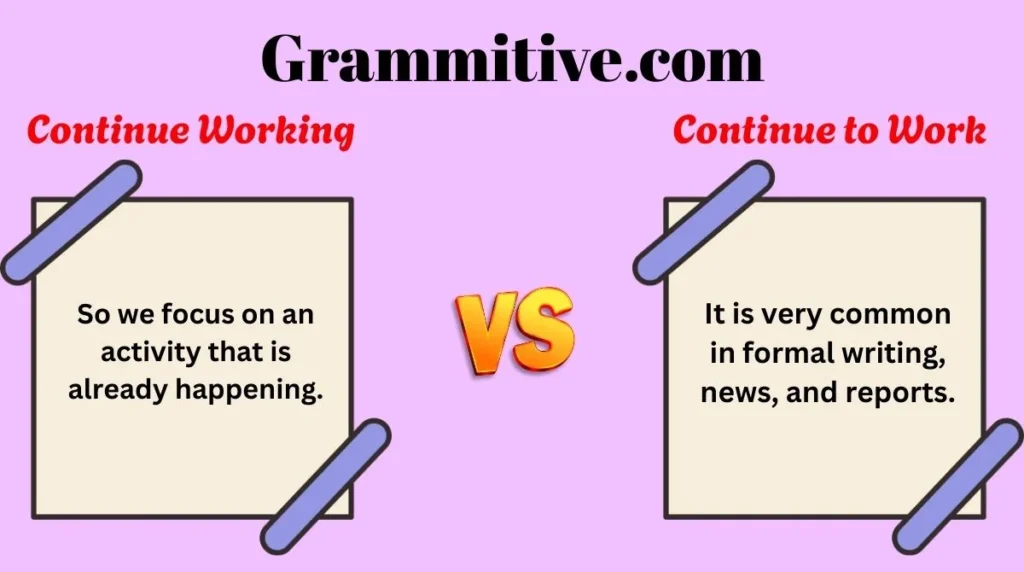
Difference Between Continue Working and Continue to Work (Detailed)
The truth is simple:
👉 In most cases, BOTH are correct.
But there are small differences in feeling and usage.
Quick comparison table
| Feature | Continue working | Continue to work |
|---|---|---|
| Grammar form | gerund (-ing) | infinitive (to + verb) |
| Tone | casual, natural | slightly formal |
| Focus | ongoing activity | action or result |
| Common in | speech | writing, reports |
| Meaning | keep doing | keep doing |
Usage difference
Continue working
- sounds more relaxed
- used often in conversation
- focuses on the action happening now
Continue to work
- sounds more formal or careful
- common in academic or business writing
- often talks about situations or facts
Grammar logic
Gerund (-ing):
👉 feels like an activity
Infinitive (to + verb):
👉 feels like an action or purpose
So:
- working = activity
- to work = action
The difference is small but real.
Sentence structure difference
Gerund:
She continued working late.
Infinitive:
She continued to work late.
Both are grammatically correct.
Meaning comparison
In daily life:
These two sentences mean almost the same:
- He continued working after dinner.
- He continued to work after dinner.
Native speakers use both without thinking much.
So don’t worry too much. Just choose the one that feels natural.
Grammar Rules You Must Remember
Rule #1: Continue can take both forms
Both are correct.
✅ She continued studying.
✅ She continued to study.
Rule #2: Use -ing for ongoing actions
When the activity is already happening, -ing sounds smooth.
✅ Please continue reading.
✅ Keep going, continue running.
Rule #3: Use “to + verb” in formal writing
Reports, news, and essays often prefer infinitives.
✅ The population continues to grow.
✅ The system continues to improve.
Rule #4: Never use both together
❌ continue to working
❌ continue working to
Only choose one pattern.
Correct:
✅ continue working
✅ continue to work
Common Mistakes Students Make
Why mistakes happen
Because:
- many verbs use only one pattern (like enjoy + -ing)
- learners try to follow strict rules
- they overthink small differences
Wrong vs correct examples
❌ She continued to working late.
✅ She continued working late.
❌ He continued work.
✅ He continued working.
❌ They continued to talking.
✅ They continued talking.
❌ We continue work tomorrow.
✅ We continue to work tomorrow.
Easy correction tips
Remember:
- after to → base verb
- after -ing → add -ing
If you see two endings together, it’s wrong.
Easy Trick to Remember the Difference
Here’s a simple memory trick.
Think like this:
👉 -ing = doing now
👉 to + verb = action or plan
So:
- working = you are already busy
- to work = just the action
Example:
Imagine your teacher says:
“Continue working.”
You are already doing homework.
Now imagine a news report:
“The company continues to work on the project.”
That sounds more formal.
So:
Casual → -ing
Formal → to + verb
Easy.

Daily Life Examples (Very Important)
These are sentences you may hear every day.
- Please continue working. Break time is later.
- I continued studying after dinner.
- He continued to work even when he felt tired.
- She continued talking on the phone for hours.
- They continue to live in the same house.
- The baby continued crying all night.
- We continued to wait for the bus.
- He continued playing video games.
- The lights continued to shine.
- She continued writing her diary.
Notice how both forms appear naturally in speech.
Native speakers don’t worry too much. They just talk.
Practice Section
Choose the correct option.
1
She continued ___ after everyone left.
a) working
b) to work
2
Please continue ___ your homework.
a) doing
b) to doing
3
The company continues ___ every year.
a) growing
b) to grow
4
He continued ___ despite the noise.
a) sleeping
b) to sleeping
5
We continued ___ for help.
a) to wait
b) waiting
Answers
1 → both possible
2 → doing
3 → both possible (to grow sounds more formal)
4 → sleeping
5 → both possible
FAQs
What is the difference between continue working and continue to work?
The meaning is almost the same. Both mean “keep doing something.” The -ing form sounds more natural in speech, while the infinitive sounds slightly more formal.
Can we use continue + ing and continue + to verb interchangeably?
Yes, in most situations you can. Native speakers often use both. Only the tone changes a little.
Is continue working informal?
It is not informal, but it sounds more relaxed and conversational. People use it a lot in daily speech.
Is continue to work more formal?
Yes, it often appears in writing, reports, and news. It sounds slightly more structured and professional.
Which form is better for exams?
Both are correct. Teachers usually accept both unless the sentence needs a specific style. Choose one that fits the sentence naturally.
Can continue be used in questions?
Yes.
Examples:
“Should we continue working?”
“Will the team continue to work tomorrow?”
Both forms work in questions.
Final Conclusion
Small grammar points like this can feel confusing at first. Two forms. Same meaning. Slight differences. It’s easy to overthink.
But the good news is simple.
Both continue working and continue to work are correct and natural English. One is not better than the other. The real difference is just style and feeling.
If you are speaking casually, the -ing form often sounds smooth and friendly. If you are writing something formal, the infinitive form may sound cleaner.
That’s it.
No scary rules. No complicated grammar.
Listen to native speakers. Read more. Practice making your own sentences. Soon, choosing the right form will feel automatic.
Keep practicing. Keep learning. And yes — continue working on your English every day.

I am Lucas Bennett, a digital content creator passionate about social media trends and online growth strategies.
I share practical insights and guides to help users better understand and navigate the digital world.