
Many English learners feel nervous when they see two words that look almost the same.
Contiguous and continuous are perfect examples.
Both words start with “conti–”.
Both sound formal.
Both are often used in books, news, and school writing.
So it’s easy to mix them up.
Students often say things like:
❌ “The rain was contiguous for three hours.”
❌ “The houses are continuous to each other.”
These sentences sound strange to native speakers. But the mistake is very common.
The problem is simple: the words talk about two different ideas.
- One is about touching space
- The other is about unbroken time
If you confuse space and time, you choose the wrong word.
Understanding this difference is very important in daily English. You may see these words in:
- geography
- news reports
- academic writing
- exams (IELTS, TOEFL, school tests)
- workplace English
By the end of this guide, you will clearly understand:
- what each word means
- when to use each one
- easy grammar rules
- real-life examples
- common mistakes
- memory tricks
After that, you won’t hesitate anymore. You’ll simply know which word sounds right.
What Does “Contiguous” Mean?
Simple definition
Contiguous = touching or connected side-by-side
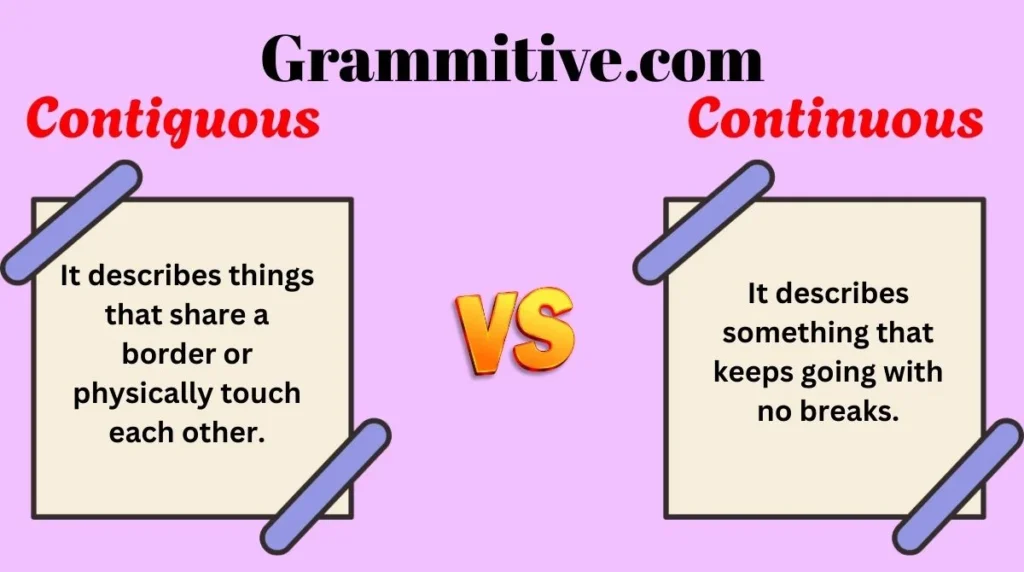
It describes things that share a border or physically touch each other.
Think about space and position, not time.
When to use it
Use contiguous when:
- areas touch each other
- buildings share walls
- land connects directly
- objects are next to each other without gaps
It is often used in:
- maps
- geography
- property/land descriptions
- formal or academic writing
Grammar rule
Contiguous + to/with + noun
Examples:
- contiguous to the park
- contiguous with the building
Example sentences (6–8)
- The two houses are contiguous.
- Our land is contiguous to the river.
- The hotel rooms are contiguous, so the families stayed close.
- These countries are contiguous, sharing the same border.
- We bought three contiguous plots of land.
- The offices are contiguous with each other.
- The farms form one contiguous area.
- The states are contiguous, not separated by water.
Common learner confusion
Students often think:
“Contiguous means continuous.”
But that’s wrong.
Contiguous = touching
NOT = happening without stopping
For example:
❌ The music was contiguous for two hours.
(Music doesn’t “touch” — this makes no sense.)
What Does “Continuous” Mean?
Simple definition
Continuous = happening without stopping
It describes something that keeps going with no breaks.
Think about time and flow, not space.
When to use it
Use continuous when:
- something lasts for a long time
- something doesn’t pause
- something happens again and again without interruption
Common situations:
- rain
- noise
- work
- movement
- actions
Grammar rule
Continuous + noun
Examples:
- continuous rain
- continuous noise
- continuous growth
Example sentences (6–8)
- It rained for three continuous hours.
- The baby’s continuous crying made everyone tired.
- We need continuous practice to improve.
- The machine runs in continuous operation.
- There was continuous traffic on the road.
- She worked continuously all night.
- The teacher gave continuous support.
- The noise was continuous and annoying.
Common learner confusion
Students sometimes use it for space:
❌ The houses are continuous.
(Not correct if you mean “touching.”)
It should be:
✔ The houses are contiguous.
Because we are talking about position, not time.
Difference Between Contiguous and Continuous (Detailed)
Even though these words look similar, their meanings are completely different.
One talks about where things are.
The other talks about how long things happen.
Quick comparison table
| Feature | Contiguous | Continuous |
|---|---|---|
| Main idea | Touching/connected | Without stopping |
| Talks about | Space/location | Time/duration |
| Common use | Land, borders, buildings | Rain, work, sound |
| Type | More formal/technical | Common everyday word |
| Example | Contiguous states | Continuous rain |
Usage difference
Contiguous → physical connection
If you can draw it on a map or touch it with your hand, use contiguous.
Continuous → time flow
If it lasts or continues in time, use continuous.
Grammar logic
Ask yourself:
👉 Am I describing position or time?
- Position → contiguous
- Time → continuous
Sentence structure difference
Contiguous
- contiguous land
- contiguous to the park
- contiguous rooms
Continuous
- continuous noise
- continuous rain
- continuous effort
Notice:
- contiguous often uses to/with
- continuous usually describes actions or events
Meaning comparison
Look at these:
- contiguous buildings → buildings touching
- continuous building → one building without breaks
See the difference? Small change, big meaning.
Grammar Rules You Must Remember
Rule #1: Use contiguous for touching things
✔ The shops are contiguous.
❌ The shops are continuous.
Rule #2: Use continuous for time without breaks
✔ She spoke for five continuous minutes.
❌ She spoke for five contiguous minutes.
Rule #3: Contiguous often appears in formal or technical English
✔ contiguous territories
✔ contiguous zones
You won’t hear it much in casual daily talk.
Rule #4: Continuous has an adverb form “continuously”
✔ He worked continuously all day.
(There is no common “contiguously” in daily speech.)
Common Mistakes Students Make
These mistakes happen because:
- the words look similar
- both sound formal
- both begin with “conti–”
- learners translate directly from their own language
Let’s fix some common errors.
Mistake 1
❌ The rain was contiguous all night.
✔ The rain was continuous all night.
Tip: Rain = time → continuous
Mistake 2
❌ Our houses are continuous.
✔ Our houses are contiguous.
Tip: Houses touch → contiguous
Mistake 3
❌ Continuous countries share borders.
✔ Contiguous countries share borders.
Tip: Borders = space → contiguous
Mistake 4
❌ I studied contiguous for three hours.
✔ I studied continuously for three hours.
Tip: studying time → continuous/continuously
Easy correction tips
Always ask:
- Can I touch it? → contiguous
- Does it last over time? → continuous
This question fixes 95% of mistakes.
Easy Trick to Remember the Difference
Here’s a simple memory trick my students love.
Contiguous → “Contact”
Both start with C.
Contact = touching
Contiguous = touching
Continuous → “Continue”
Both start with Continu–
Continue = keep going
Continuous = keep going
So:
- Contact → contiguous
- Continue → continuous
Easy and logical.
Daily Life Examples (Very Important)
Now let’s use real spoken English.
These are sentences you might hear every day.
- Our hotel rooms are contiguous, so we can visit easily.
- The rain has been continuous since morning.
- These two farms are contiguous properties.
- There was continuous noise from the street.
- The states are contiguous, not separated by water.
- She made continuous progress in her English.
- We bought three contiguous apartments and made one big home.
- The baby’s continuous crying kept us awake.
- Their land is contiguous to the highway.
- The machine runs continuously for 24 hours.
Notice how natural these sound.
Practice Section
Choose the correct word: contiguous or continuous
- The two offices are ______.
- We had ______ rain for two days.
- These fields are ______ to each other.
- He worked ______ for six hours.
- The countries are ______ and share a border.
Answers
- contiguous
- continuous
- contiguous
- continuously
- contiguous
FAQs
1. What is the difference between contiguous and continuous?
Contiguous means things are touching or connected in space. Continuous means something happens without stopping over time. One is about position, the other is about duration.
2. Can we use contiguous in daily conversation?
It’s possible, but not common. Most people say “next to” or “touching.” Contiguous sounds more formal or technical.
3. Is continuous formal or informal?
Continuous is neutral. You can use it in both daily conversation and formal writing.
4. Which word is used for rain or noise?
Always continuous. Rain and noise happen over time, not in space.
5. Can contiguous describe time?
No. It only describes physical connection or borders. Never use it for time.
6. What part of speech are these words?
Both are adjectives. They describe nouns, like land, rain, noise, or buildings.
Final Conclusion
Small differences between English words can create big confusion. Contiguous and continuous are a perfect example. They look almost the same, yet their meanings live in two different worlds.
Remember the core idea:
Contiguous → space and touching
Continuous → time and no breaks
When you think about borders, land, buildings, or physical position, choose contiguous. When you talk about rain, noise, work, or anything that keeps going, choose continuous.
Try to notice these words in news articles, books, and conversations. The more you see them, the more natural they will feel. Practice writing your own sentences too. Even five minutes a day helps a lot.
Soon, you won’t stop and think. The correct word will simply come to your mind.
That’s when real learning happens.

I am Lucas Bennett, a digital content creator passionate about social media trends and online growth strategies.
I share practical insights and guides to help users better understand and navigate the digital world.