
Consist
Many English learners feel confused when they see consist in and consist of.
The words look almost the same. The verb consist is the same. Only the small preposition changes: in or of.
But that tiny change creates a big difference in meaning.
You might hear sentences like:
- “The team consists of five players.”
- “Happiness consists in being grateful.”
Both are correct. Yet they talk about completely different ideas.
This is where students get stuck.
They ask:
“Why of here?”
“Why in there?”
“Can I use them the same way?”
The short answer: No. They are not interchangeable.
Understanding this difference is important because these phrases appear everywhere — in books, exams, essays, news, and even daily conversations. If you mix them up, your sentence may sound strange or incorrect.
After reading this guide, you will clearly understand:
- What consist of really means
- What consist in really means
- When to use each one
- Grammar rules
- Easy memory tricks
- Common mistakes
- Lots of simple examples
By the end, choosing the right phrase will feel natural — not confusing.
What Does “Consist Of” Mean?
Simple definition
Consist of = to be made of / to include parts
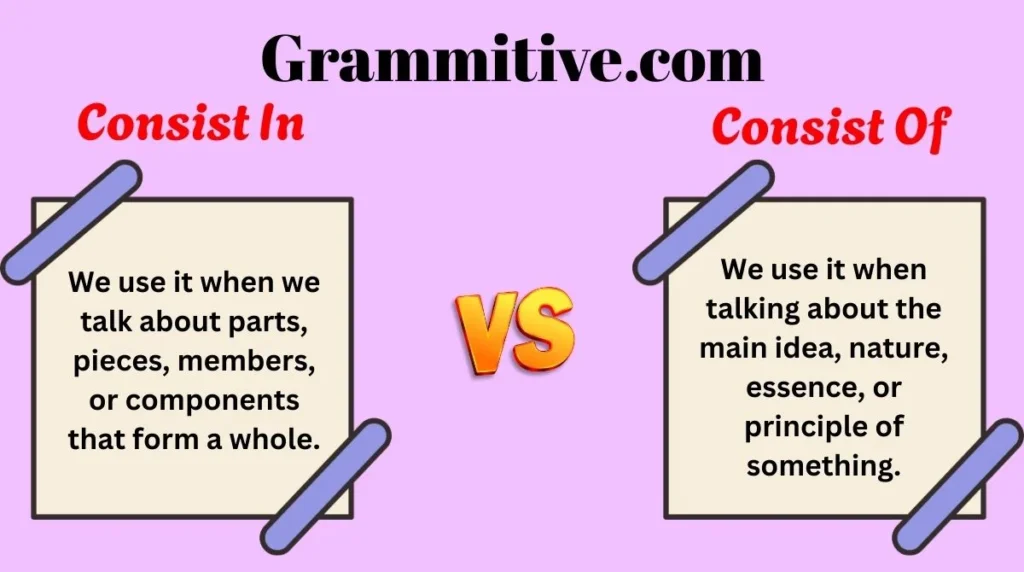
We use it when we talk about parts, pieces, members, or components that form a whole.
Think:
👉 What parts make this thing?
If you can list items, you probably need consist of.
When to use it
Use consist of when:
- Talking about ingredients
- Talking about members of a group
- Talking about parts of something
- Listing what something includes
Grammar rule
Structure:
Subject + consist(s) of + parts/things
Examples:
- The cake consists of flour, sugar, and eggs.
- The class consists of 20 students.
Notice something important:
❌ No passive form
❌ Not “is consisted of”
Always active voice only.
Example sentences (6–8)
- The team consists of eleven players.
- My lunch consists of rice and vegetables.
- The book consists of ten chapters.
- The committee consists of three teachers.
- Water consists of hydrogen and oxygen.
- The job consists of answering customer calls.
- The house consists of two bedrooms and a kitchen.
- Our trip consists of three days of hiking.
Common learner confusion
Students often say:
❌ The team consists in eleven players.
This sounds wrong because players are parts, not an idea or principle.
Remember: parts → of
What Does “Consist In” Mean?
Simple definition
Consist in = to be based on / to lie in / to depend on
We use it when talking about the main idea, nature, essence, or principle of something.
This is more abstract.
Think:
👉 What is the true meaning or secret of this thing?
Not parts. Not pieces.
But the core idea.
When to use it
Use consist in when:
- Talking about meaning
- Talking about importance
- Talking about the true nature of something
- Talking about principles or qualities
Grammar rule
Structure:
Subject + consist(s) in + idea/quality/principle
Examples:
- Happiness consists in loving others.
- Success consists in hard work.
We usually follow it with:
- gerunds (-ing)
- abstract nouns
- ideas
Example sentences (6–8)
- True happiness consists in helping others.
- Success consists in working hard every day.
- Beauty consists in simplicity.
- Good health consists in eating well and exercising.
- Wisdom consists in learning from mistakes.
- Confidence consists in believing in yourself.
- The secret consists in careful planning.
- Peace consists in understanding each other.
Common learner confusion
Students sometimes say:
❌ The meal consists in rice and soup.
This is wrong because rice and soup are parts, not ideas.
So we must say:
✔ The meal consists of rice and soup.
Difference Between Consist In and Consist Of (Detailed)
Understanding the difference becomes easier when you compare them side by side.
Quick Comparison Table
| Feature | Consist of | Consist in |
|---|---|---|
| Meaning | made of parts | based on idea |
| Use for | things, items, members | qualities, principles |
| Concrete/Abstract | concrete | abstract |
| Example | cake consists of flour | happiness consists in gratitude |
| Question form | What parts? | What is the essence? |
Usage difference
Consist of → physical or countable parts
- people
- objects
- ingredients
- components
Consist in → abstract meaning
- ideas
- values
- feelings
- principles
Grammar logic
If you can count it → of
If you can feel or think it → in
Sentence structure difference
Consist of
Nouns that are things
- chairs
- pages
- students
- ingredients
Consist in
Ideas or actions
- honesty
- patience
- working hard
- believing
Meaning comparison
Look at this:
- The team consists of five members. → parts
- Success consists in teamwork. → idea
See the difference?
First = structure
Second = meaning
Grammar Rules You Must Remember
Rule #1 – Never use passive voice
❌ The cake is consisted of flour.
✔ The cake consists of flour.
The verb consist is always active.
Rule #2 – Use “of” for parts
✔ The box consists of toys.
Not in
Rule #3 – Use “in” for ideas
✔ Happiness consists in being kind.
Not of
Rule #4 – Usually followed by gerund with “in”
✔ Success consists in trying again.
Gerund (-ing) sounds natural here.
Common Mistakes Students Make
Mistakes happen because both phrases look similar. The brain thinks they mean the same thing.
But they don’t.
Let’s fix the most common problems.
Mistake 1
❌ The class consists in 30 students.
✔ The class consists of 30 students.
Tip: students = countable parts
Mistake 2
❌ Success consists of hard work.
✔ Success consists in hard work.
Tip: hard work = idea
Mistake 3
❌ The pizza is consisted of cheese.
✔ The pizza consists of cheese.
Tip: never passive
Mistake 4
❌ Happiness consists of helping others.
✔ Happiness consists in helping others.
Tip: feelings → in
Easy correction tip
Ask yourself:
👉 Can I touch it or count it?
Yes → of
No → in
Easy Trick to Remember the Difference
Here’s a simple memory trick students love.
Think about this:
OF = pieces OF a puzzle
You can see them. You can count them.
IN = meaning IN your heart
You feel it. You cannot touch it.
So:
- Parts → of
- Meaning → in
Very simple.
Another trick:
OF = Objects
Both start with O
IN = Ideas
Both start with I
Easy, right?
Daily Life Examples (Very Important)
These sentences sound natural in everyday English. Imagine hearing them in conversations.
- My breakfast consists of eggs and toast.
- The group consists of five friends.
- The movie consists of three short stories.
- Real friendship consists in trust.
- Good parenting consists in listening to children.
- The package consists of two books and a pen.
- Success in school consists in regular study.
- Our plan consists of visiting three cities.
- Happiness often consists in small moments.
- The course consists of six online lessons.
Notice how natural they sound. Native speakers use them this way all the time.
Practice Section
Choose the correct option: in or of
Questions
- The cake consists ___ sugar and butter.
- Success consists ___ hard work.
- The club consists ___ 15 members.
- Happiness consists ___ loving others.
- The machine consists ___ many small parts.
Answers
- of
- in
- of
- in
- of
FAQs
1. What is the difference between consist in and consist of?
Consist of talks about parts or members.
Consist in talks about the main idea or essence.
Think parts vs meaning.
2. Can we use consist in everyday English?
Yes, but it sounds slightly formal.
It appears more in writing, speeches, or serious conversations.
Still correct and common.
3. Can we use consist of in questions?
Yes.
Example: “What does the course consist of?”
Very common in spoken English.
4. Is consist of more common than consist in?
Yes.
Because we often talk about parts and ingredients.
So you will hear consist of much more often.
5. Can we say “is consisted of”?
No. Never.
The verb consist does not use passive form.
Always active: “consists of.”
6. Are these phrases formal or informal?
They are neutral.
Good for both speaking and writing.
But consist in sounds a bit more formal or academic.
Final Conclusion
Small grammar differences can feel scary at first. A tiny preposition like in or of changes the whole meaning of a sentence. That’s why many learners mix them up.
But now the difference is clear and simple.
Use consist of when talking about parts, pieces, or members.
Use consist in when talking about ideas, meaning, or principles.
Parts → of
Ideas → in
Practice by making your own sentences every day. Describe your meals, your class, your goals, your life. The more you use these phrases, the more natural they will sound.
Grammar becomes easy when you connect it to real life.
Keep practicing, stay curious, and don’t worry about small mistakes. That’s how real learning happens.

I am Lucas Bennett, a digital content creator passionate about social media trends and online growth strategies.
I share practical insights and guides to help users better understand and navigate the digital world.