
Many English learners feel confused when they see the words conserve and preserve.
Both words talk about saving something. Both often appear in topics like nature, history, food, and energy. Because of this, they seem almost the same.
But they are not the same.
A student might say, “We should preserve water,” or “We must conserve old buildings.” These sentences sound close to correct, but something feels off to a native speaker. The reason is simple: each word has a slightly different purpose.
Small differences in English can change the meaning a lot. Using the wrong word can make your sentence sound strange or unnatural.
This is why understanding these two words is important for daily English, school writing, exams, and even conversations about the environment.
By the end of this guide, you will clearly understand:
- What conserve means
- What preserve means
- When to use each one
- The grammar patterns
- Easy tricks to remember
- Real-life examples you can actually say
Everything is explained in simple, friendly English. Think of this as a classroom talk with a teacher who wants you to feel confident, not confused.
What Does “Conserve” Mean?
Simple definition
Conserve = to save something carefully so it does not run out or get wasted.
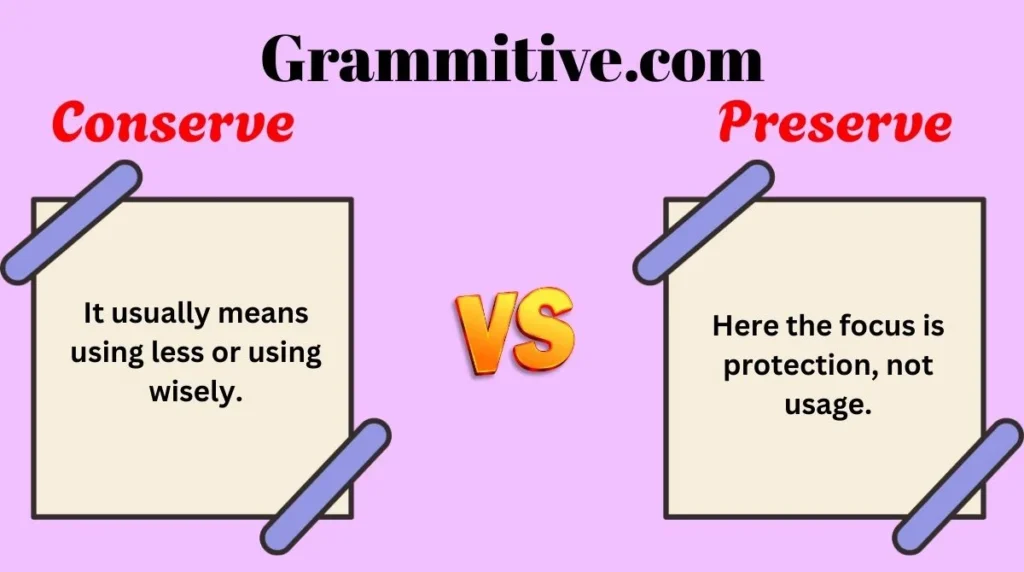
It usually means using less or using wisely.
When you conserve something, you still use it, but you use it slowly and carefully.
When to use it
We use conserve for:
- water
- electricity
- fuel
- energy
- money
- natural resources
- time
These are things that can finish or decrease if we waste them.
Grammar rule
Conserve + noun
It is mostly used as a verb.
Examples:
- conserve water
- conserve energy
- conserve fuel
Rarely used as a noun. Mostly a verb in everyday English.
Example sentences
- We must conserve water during the summer.
- Turn off the lights to conserve electricity.
- The country is trying to conserve fuel.
- She conserved her money for college.
- Walking instead of driving helps conserve energy.
- Farmers conserve water by using smart irrigation systems.
- We should conserve our natural resources.
- He conserved his strength before the race.
Common learner confusion
Many learners think conserve means “protect completely.”
But that is not right.
Remember:
Conserve = still use, but carefully.
For example:
You don’t stop using water. You just use less.
What Does “Preserve” Mean?
Simple definition
Preserve = to protect something so it stays the same and does not get damaged, changed, or destroyed.
Here the focus is protection, not usage.
Sometimes it means keep safe forever.
When to use it
We use preserve for:
- history
- old buildings
- culture
- traditions
- food
- forests
- wildlife
- memories
- documents
These are things we want to keep safe or unchanged.
Grammar rule
Preserve + noun
Used as a verb most of the time.
But it can also be a noun:
- fruit preserves (jam)
Example sentences
- The museum preserves ancient art.
- We must preserve our culture.
- This law helps preserve wildlife.
- They preserved the old house.
- Salt helps preserve food.
- The photo helps preserve memories.
- The government works to preserve national parks.
- These documents are preserved for history.
Common learner confusion
Students sometimes use preserve when they mean “use less.”
Example:
❌ Preserve water
This sounds unnatural.
Because water is not something we protect from change. We simply use less of it.
So we say:
✔ Conserve water
Remember:
Preserve = protect, not use
Difference Between Conserve and Preserve (Detailed)
The difference is small but important.
Think like this:
- Conserve → careful use
- Preserve → full protection
Quick comparison table
| Feature | Conserve | Preserve |
|---|---|---|
| Main idea | Use less | Protect |
| Purpose | Prevent waste | Prevent damage/change |
| Still used? | Yes | Usually no |
| Common topics | water, energy, fuel | culture, food, buildings |
| Feeling | save for later | keep safe forever |
Usage difference
If something can run out, we usually conserve it.
If something can get damaged or destroyed, we usually preserve it.
Grammar logic
Both are verbs, but their meanings guide the noun that follows.
- conserve + resources
- preserve + history/things
Sentence structure difference
- We conserve electricity at home.
- The museum preserves history.
Notice how the objects are different types of things.
Meaning comparison
Imagine a chocolate cake.
If you conserve it → you eat small pieces slowly.
If you preserve it → you freeze it so it stays fresh.
See the difference? One is careful use. One is protection.
Grammar Rules You Must Remember
Rule #1: Conserve is mostly about resources
✔ We conserve water.
✔ We conserve fuel.
If it’s something you consume, choose conserve.
Rule #2: Preserve is about protection or history
✔ They preserved the old temple.
✔ The forest is preserved.
If something must stay safe and unchanged, choose preserve.
Rule #3: Both are transitive verbs
They need an object.
❌ We conserve.
✔ We conserve energy.
❌ They preserved.
✔ They preserved the building.
Rule #4: Preserve can also be a noun (food)
✔ I like strawberry preserves.
Conserve is rarely a noun in daily English.
Common Mistakes Students Make
Why mistakes happen
Because both words mean “save,” students translate directly from their first language. Many languages only have one word for both ideas.
But English separates them.
Wrong vs Correct
❌ We must preserve electricity.
✔ We must conserve electricity.
❌ The government conserved the old fort.
✔ The government preserved the old fort.
❌ She conserved the painting.
✔ She preserved the painting.
Easy correction tips
Ask yourself:
- Is it used slowly? → conserve
- Is it protected from damage? → preserve
That question solves most problems.
Easy Trick to Remember the Difference
Here’s a simple memory trick my students love.
C = Consume slowly
Conserve → starts with C
C → Consume carefully
You still use it, just slowly.
P = Protect
Preserve → starts with P
P → Protect
You keep it safe.
So think:
Conserve = Careful use
Preserve = Protect
Very easy.
Daily Life Examples (Very Important)
These sound like real conversations.
- Please turn off the tap. We need to conserve water.
- Let’s conserve our phone battery.
- This fridge helps preserve food longer.
- The town wants to preserve its old streets.
- I’m trying to conserve money this month.
- They preserved their wedding photos carefully.
- We should conserve fuel by carpooling.
- The park is preserved for wildlife.
- Close the door to conserve heat.
- The recipe helps preserve vegetables for winter.
Say these out loud. They feel natural.
Practice Section
Choose the correct word: conserve or preserve.
- We should ______ energy at home.
- The museum wants to ______ ancient coins.
- Please ______ water while brushing your teeth.
- Salt helps ______ fish.
- The city plans to ______ historic buildings.
Answers
- conserve
- preserve
- conserve
- preserve
- preserve
FAQs (SEO Focused)
What is the difference between conserve and preserve?
Conserve means using something carefully so it does not run out. Preserve means protecting something so it does not get damaged or changed. One is about careful use, the other is about protection.
Can we use conserve and preserve in the same sentence?
Yes. Example:
“We must conserve water and preserve forests.”
Each word matches a different type of object.
Is conserve formal or informal?
It is neutral. You can use it in daily speech, school writing, and formal reports. It sounds natural everywhere.
Is preserve used for food?
Yes. Preserve can mean keeping food fresh for a long time using salt, sugar, or cold. It can also be a noun like “fruit preserves.”
Why can’t we say preserve electricity?
Because electricity is something we use, not protect from damage. We reduce usage. So the correct word is conserve electricity.
Which word is common in environmental topics?
Both. We conserve energy and water, but preserve forests, wildlife, and historical places. Each has its own role.
Final Conclusion
The difference between these two words becomes clear once you stop thinking of them as twins. They are more like cousins. Similar, but not the same.
When something might run out, you use it wisely. That is conserve. When something might be lost, damaged, or forgotten, you protect it. That is preserve.
This small idea changes everything.
With practice, the choice becomes natural. Read signs, watch news stories about the environment, and notice how native speakers use these words. Try making your own sentences every day. Even five minutes of practice helps a lot.
Soon, you won’t stop and think. You’ll just know which word feels right.
And that’s the goal of good English.

I am Lucas Bennett, a digital content creator passionate about social media trends and online growth strategies.
I share practical insights and guides to help users better understand and navigate the digital world.