
Many English learners feel confused when they see two words that look almost the same but are spelled a little differently.
One small letter changes everything. You stop and think, “Are these two different words? Or is one wrong?”
That’s exactly what happens with coliseum and colosseum.
You might read Colosseum in a history book about Rome. Then you open a travel blog and see Coliseum. Later, you notice a stadium in the U.S.
called “Veterans Memorial Coliseum.” Now your brain starts asking questions.
Which spelling is correct?
Are both right?
Do they mean the same thing?
Is one British and the other American?
These doubts are normal, especially for non-native speakers. English has many words like this. Small spelling changes can create big confusion.
Understanding this topic is useful in real life. You may see these words in movies, news articles, travel guides, sports stadium names, or exam questions.
Knowing the difference helps you write clearly and sound more natural.
By the end, everything will feel simple. You’ll know what each word means, when to use it, how to remember it, and how to avoid common mistakes.
What Does “Coliseum” Mean?
Simple definition
Coliseum is a noun.
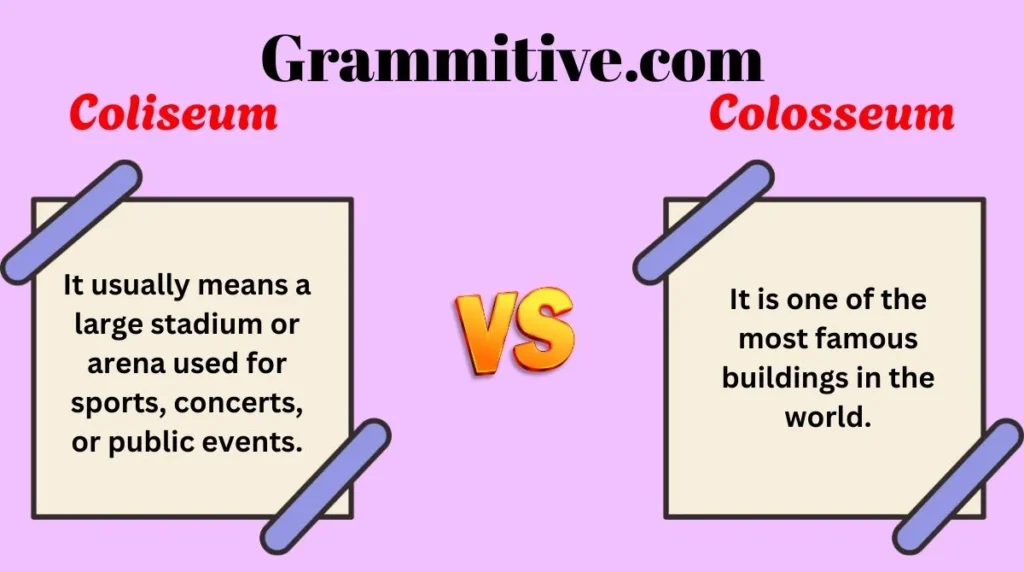
It usually means a large stadium or arena used for sports, concerts, or public events.
It can also be a modern spelling variation of Colosseum, but today it is mostly used for general buildings, not the famous Roman one.
When to use it
Use coliseum when you talk about:
- Modern sports arenas
- Event centers
- Stadiums in American English
- Buildings used for basketball, concerts, wrestling, or shows
Many places in the United States use this spelling in their official names.
Grammar rule
- It is a countable noun
- Singular: coliseum
- Plural: coliseums
Examples:
- a coliseum
- two coliseums
Example sentences
- The concert will be held at the city coliseum.
- Thousands of fans filled the coliseum last night.
- Our basketball team practices in the college coliseum.
- The new coliseum has comfortable seats.
- They built a huge coliseum for the Olympic games.
- The coliseum hosts music shows every weekend.
- We waited outside the coliseum for two hours.
- The old coliseum was renovated last year.
Common learner confusion
Many students think coliseum is wrong spelling. That’s not true.
It’s correct, but it is usually used for modern buildings, not the ancient Roman monument.
So the word is correct — just used in a different context.
What Does “Colosseum” Mean?
Simple definition
Colosseum (sometimes spelled Coliseum in older English) is the famous ancient amphitheater in Rome, Italy.
It is one of the most famous buildings in the world.
When people say “the Colosseum”, they usually mean that specific historical structure.
When to use it
Use Colosseum when talking about:
- The Roman monument
- Ancient Roman history
- Gladiators
- Tourist attractions in Rome
- Historical writing
It is often capitalized because it is a proper noun (a specific place).
Grammar rule
- Proper noun → usually capitalized
- Singular only (one famous building)
- No common plural use
You usually say:
- the Colosseum
Not: - a Colosseum
Example sentences
- We visited the Colosseum in Rome.
- The Colosseum is over 2,000 years old.
- Gladiators fought inside the Colosseum.
- Millions of tourists see the Colosseum every year.
- The Colosseum is a symbol of ancient Rome.
- I took many photos near the Colosseum.
- The Colosseum looks beautiful at sunset.
- History books often describe life inside the Colosseum.
Common learner confusion
Students often write:
❌ I saw the coliseum in Rome.
While this is sometimes accepted in American spelling, Colosseum is the traditional and historically correct name.
For exams, academic writing, and travel writing, Colosseum is safer.
Difference Between Coliseum and Colosseum (Detailed)
At first glance, they look almost identical. But their usage and meaning are slightly different.
Quick comparison table
| Feature | Coliseum | Colosseum |
|---|---|---|
| Meaning | Modern stadium or arena | Ancient Roman amphitheater |
| Usage | General/common noun | Specific proper noun |
| Capital letter | Not necessary | Usually capitalized |
| Plural | Coliseums | Rarely used |
| Region | Common in American English | Used worldwide for the Roman site |
| Example | sports coliseum | the Colosseum in Rome |
Usage difference
Think of it like this:
- Colosseum = one famous historical building
- Coliseum = any large event arena
So the first is specific, the second is general.
Grammar logic
Colosseum behaves like:
- the Eiffel Tower
- the Taj Mahal
It is a unique place.
Coliseum behaves like:
- stadium
- arena
- theater
It is a common noun.
Sentence structure difference
Notice the articles:
✔ the Colosseum (specific)
✔ a coliseum (general)
You wouldn’t say:
❌ a Colosseum in my city
Because there is only one real Colosseum.
Meaning comparison
- Colosseum → history, Rome, gladiators
- Coliseum → sports, music, modern events
Very different feelings and images.
Grammar Rules You Must Remember
Rule #1: Capitalize “Colosseum”
Because it is a proper name.
✔ We toured the Colosseum.
❌ We toured the colosseum.
Rule #2: “Coliseum” is countable
You can use plural.
✔ The city has two coliseums.
❌ The city has two Colosseums.
Rule #3: Use “the” with Colosseum
It’s a specific monument.
✔ the Colosseum
❌ a Colosseum
Rule #4: Use “a/an” with coliseum
Because it is general.
✔ a coliseum near my house
✔ an indoor coliseum
Common Mistakes Students Make
Why mistakes happen
There are three big reasons:
- Similar spelling
- Same pronunciation
- Both talk about large buildings
Your brain thinks they must be the same. But usage is different.
Wrong vs correct examples
❌ We played basketball in the Colosseum.
✔ We played basketball in the coliseum.
❌ I visited a coliseum in Rome.
✔ I visited the Colosseum in Rome.
❌ The colosseum downtown has a concert tonight.
✔ The coliseum downtown has a concert tonight.
Easy correction tips
Ask yourself:
👉 Is it the famous Roman building? → Colosseum
👉 Is it a modern stadium? → coliseum
That simple question fixes 90% of errors.
Easy Trick to Remember the Difference
Here’s a fun memory trick students love.
Look at the spelling:
ColoSSSeum → double S
Those two big S letters look like snakes or swords, like ancient gladiator fights.
So:
- Double S → history → Rome → Colosseum
Now look at:
Coliseum → simpler spelling
Modern buildings are simpler.
So:
- Simple spelling → modern stadium → coliseum
It sounds silly, but it sticks in your memory.
Daily Life Examples (Very Important)
Here’s how people naturally use these words in conversation.
- “The game is at the coliseum tonight.”
- “Let’s meet outside the coliseum entrance.”
- “Have you ever seen the Colosseum in person?”
- “The Colosseum looks amazing in photos.”
- “They’re building a new coliseum downtown.”
- “The concert was packed. The coliseum was full.”
- “We walked around the Colosseum for hours.”
- “My dad works at the city coliseum.”
- “Tourists love the Colosseum at night.”
- “The basketball finals will be at the main coliseum.”
Notice how natural and simple these sound. That’s real English.
Practice Section
Choose the correct word: coliseum or Colosseum
- We toured the ______ in Rome.
- The concert is at the new ______.
- Gladiators fought inside the ______.
- Our city built a sports ______ last year.
- The ______ is one of Italy’s top attractions.
Answers
- Colosseum
- coliseum
- Colosseum
- coliseum
- Colosseum
FAQs
1. What is the difference between coliseum and Colosseum?
Coliseum usually means a modern stadium or arena. Colosseum refers to the famous ancient Roman building. One is general, the other is specific.
2. Can both spellings be correct?
Yes. Both are correct English words. They just have different uses. Context decides which one fits.
3. Which spelling should I use for Rome?
Use Colosseum. That is the historical and internationally accepted name.
4. Is coliseum American English?
Mostly yes. Many American stadiums use “coliseum” in their names. It’s common in the U.S.
5. Can I say “a Colosseum”?
No. It sounds strange because there is only one famous Colosseum. Use “the Colosseum.”
6. Do they sound different?
No. They are pronounced almost the same. That’s why learners often mix them up.
Final Conclusion
Small spelling differences can cause big confusion in English, especially when the words sound identical.
Coliseum and Colosseum are a perfect example. But once you understand the logic, the choice becomes easy.
Think of Colosseum as history. Ancient Rome. Gladiators. One famous monument. Always capitalized.
Think of coliseum as modern life. Sports games. Concerts. Local arenas. Many buildings.
That simple idea clears everything.
Next time you read or write about a stadium or a trip to Rome, you won’t hesitate. You’ll pick the right word naturally.
Keep practicing with real sentences. Notice how newspapers and travel blogs use them. Little by little, these details become automatic.
English gets easier when you break things into small, clear rules. And now this pair of words is one less thing to worry about.

I am Lucas Bennett, a digital content creator passionate about social media trends and online growth strategies.
I share practical insights and guides to help users better understand and navigate the digital world.