
English has many small phrases that look similar but behave very differently.
“By which” and “in which” are perfect examples.
They are short. Only two words each. But they confuse thousands of learners every day.
Students often stop in the middle of a sentence and think:
Should I say by which… or in which?
Do they mean the same thing?
Why does one sound right and the other wrong?
Even advanced learners mix them up.
The problem is not vocabulary. The problem is prepositions — tiny words like by, in, on, at. These words change meaning in big ways. One small change can make a sentence incorrect or unnatural.
And this topic is not just for exams.
You hear these phrases in:
- formal writing
- news articles
- academic essays
- contracts
- emails
- spoken English
So understanding them helps you read better, write clearly, and speak more naturally.
By the end of this guide, you will clearly know:
- what each phrase means
- when to use each one
- how sentence structure changes
- the exact difference between them
- easy tricks to remember forever
Everything is explained step by step, using simple English and real-life examples.
What Does “By Which” Mean?
Simple meaning
“By which” means:
👉 using something
👉 through something
👉 because of something
👉 the method or way something happens
It shows the tool, method, or action that causes a result.
Think of it like this:
by = how something happens
When to use it
Use “by which” when you talk about:
- methods
- processes
- systems
- ways to do something
- actions that create results
It often appears in formal or written English, especially in explanations.
Grammar rule
Structure:
noun + by which + clause
The clause explains how the noun works or causes something.
Example pattern:
The system by which we communicate…
Here, “by which” explains how we communicate.
Examples (6–8 sentences)
- This is the method by which we solve the problem.
- The app has a feature by which users can track expenses.
- They explained the process by which plastic is recycled.
- This is the rule by which the game is played.
- The machine uses a system by which it saves energy.
- She described the way by which the data is collected.
- We studied the steps by which plants grow.
- That is the technique by which chefs cook faster.
Common learner confusion
Many students replace it with:
- in which
- that
- where
But those words change the meaning.
Compare:
❌ The method in which we solve problems
✔ The method by which we solve problems
Why?
Because we don’t solve problems inside a method.
We solve them using a method.
So we need by, not in.
What Does “In Which” Mean?
Simple meaning
“In which” means:
👉 inside something
👉 during something
👉 within something
👉 at a time or place
It talks about location, situation, or context.
Think:
in = inside / within
When to use it
Use “in which” when you talk about:
- places
- situations
- conditions
- time periods
- environments
- settings
It shows where or when something happens.
Grammar rule
Structure:
noun + in which + clause
The clause explains what happens inside that place or situation.
Example pattern:
The room in which we met…
We met inside the room.
Examples (6–8 sentences)
- This is the house in which I grew up.
- I remember the year in which we first met.
- The city in which she lives is very crowded.
- That was the moment in which everything changed.
- This is the class in which students practice speaking.
- The box in which the gift came was beautiful.
- The situation in which we found ourselves was difficult.
- He explained the context in which the rule was created.
Common learner confusion
Students sometimes use “by which” here:
❌ The house by which I grew up
✔ The house in which I grew up
Why?
Because you grow up inside a house, not using it.
So again:
- place → in
- method → by
Difference Between “By Which” and “In Which” (Detailed)
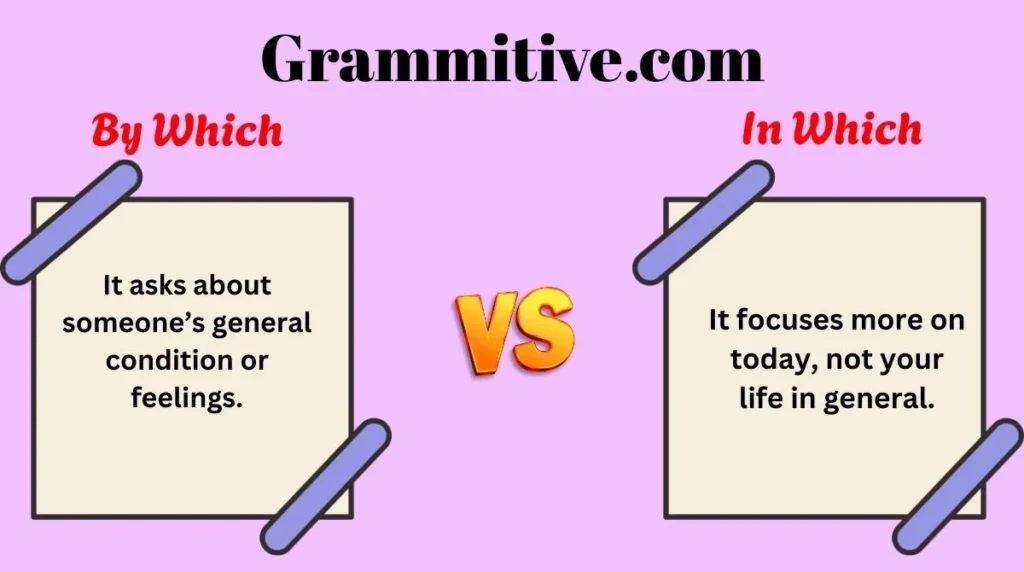
These two phrases look similar but answer different questions.
- By which → HOW?
- In which → WHERE/WHEN?
Comparison Table
| Feature | By Which | In Which |
|---|---|---|
| Basic idea | method / means | place / situation |
| Answers | How? | Where? / When? |
| Shows | tool or process | location or context |
| Similar to | using, through | inside, within |
| Example | the way by which | the place in which |
Usage difference
By which = the way something happens
The system by which payments are made
In which = the place or situation where something happens
The system in which payments are made
Notice the difference:
- first → method
- second → environment
Grammar logic
Prepositions carry meaning.
- by → movement, action, means
- in → space, position, time
So choose based on the relationship, not the grammar pattern.
Sentence structure difference
Both follow:
noun + preposition + which + clause
But the idea changes.
Example:
- The process by which food is cooked
- The kitchen in which food is cooked
Same grammar. Different meaning.
Meaning comparison
Let’s compare directly:
1️⃣ The law by which citizens vote
→ the method of voting
2️⃣ The country in which citizens vote
→ the place where voting happens
Small word. Big difference.
Grammar Rules You Must Remember
Rule #1 — Use “by which” for methods or tools
✔ The technique by which she paints
✔ The system by which data is stored
If it means using something, choose by.
Rule #2 — Use “in which” for places or situations
✔ The room in which we studied
✔ The case in which he was involved
If something happens inside, choose in.
Rule #3 — Ask yourself a question
- How does it happen? → by which
- Where/when does it happen? → in which
Example:
The year ___ we graduated
Answer: in which (when)
Rule #4 — Informal English often drops them
Formal:
The house in which I live
Informal:
The house I live in
Both are correct. Choose based on style.
Common Mistakes Students Make
Why mistakes happen
There are three main reasons:
- Translating from their first language
- Guessing because both look similar
- Not thinking about meaning
Grammar is not just structure. Meaning matters.
Wrong vs Correct examples
❌ The method in which we pay
✔ The method by which we pay
❌ The room by which we slept
✔ The room in which we slept
❌ The year by which I moved
✔ The year in which I moved
Easy correction tips
Before choosing, ask:
👉 Am I talking about a place?
👉 Or a method?
If you answer that clearly, the choice becomes easy.
Easy Trick to Remember the Difference
Here’s a simple memory trick many students love.
Think of pictures
By → hand/tool
Imagine your hand using something.
Method = by
In → box/room
Imagine something inside a box.
Place = in
So:
- using → by
- inside → in
Very simple. Very reliable.
Daily Life Examples (Very Important)
These sentences sound natural in real conversations and writing.
- That’s the app by which I order food.
- This is the café in which we first met.
- The process by which you register is easy.
- The building in which my office is located is old.
- He explained the way by which the machine works.
- That was the moment in which I realized the truth.
- The system by which tickets are booked is online now.
- The village in which she was born is very small.
- The method by which they teach kids is fun.
- The situation in which we met was strange.
These examples feel natural because they follow the method vs place rule.
Practice Section
Choose the correct option.
- The process ___ the cake is baked
a) by which
b) in which - The room ___ we had dinner
a) by which
b) in which - The technique ___ she learns fast
a) by which
b) in which - The year ___ they got married
a) by which
b) in which - The system ___ payments are made online
a) by which
b) in which
Answers
- by which
- in which
- by which
- in which
- by which
FAQs
What is the difference between “by which” and “in which”?
“By which” shows a method or means. “In which” shows a place, time, or situation. One answers how, the other answers where or when.
Can we use “by which” in questions?
Yes, especially in formal English. Example: “Do you know the method by which this works?” It sounds more formal than everyday speech.
Is “in which” formal or informal?
It is mostly formal or written. In casual speech, people often say “where” or move the preposition to the end: “the room we met in.”
Can I replace them with “that”?
Sometimes, yes. But you may lose clarity. “The method that we use” is okay, but “by which” sounds more precise and formal.
Which one is more common in daily conversation?
“In which” and “by which” are both more common in writing. In speech, people say “where,” “how,” or put the preposition at the end.
Are they used in academic writing?
Very often. Essays, research papers, and reports use both because they sound formal and precise.
Final Conclusion
Small grammar points can feel scary at first, especially when two phrases look almost the same. But once you focus on meaning, everything becomes clear.
Remember the heart of the difference:
- by which = the method or way
- in which = the place or situation
That’s it.
Whenever you feel confused, pause for a second and ask yourself one simple question: Am I talking about how something happens or where it happens? The answer will guide you.
Practice with your own sentences. Read books and notice how writers use these phrases. Try rewriting sentences in both formal and informal ways. The more you use them, the more natural they feel.
Grammar doesn’t have to be heavy or complicated. With the right examples and a little logic, even tricky phrases become easy friends.
Keep practicing, and soon you’ll use both confidently without even thinking.

I am Lucas Bennett, a digital content creator passionate about social media trends and online growth strategies.
I share practical insights and guides to help users better understand and navigate the digital world.