
Many English learners feel confused when they write sentences like:
❌ This phone is better then mine.
❌ I am better then yesterday.
Something looks strange, but it is hard to see why.
The problem comes from two small words that sound almost the same: than and then. When we speak quickly, they sound very close. Because of this, students often mix them up in writing.
But here’s the thing — these two words have completely different meanings.
One word is used for comparison.
The other word is used for time or sequence.
If you choose the wrong one, your sentence can look careless or even change meaning.
This mistake is very common in emails, exams, social media posts, and even professional writing. That’s why it is important to learn the difference clearly.
By the end of this guide, you will:
- understand exactly when to use than
- understand exactly when to use then
- see easy grammar rules
- learn memory tricks
- read many real-life examples
- stop making this mistake forever
Everything is explained in simple English, step by step, just like in a classroom.
What Does “Than” Mean?
Simple definition
Than is used to compare two things.
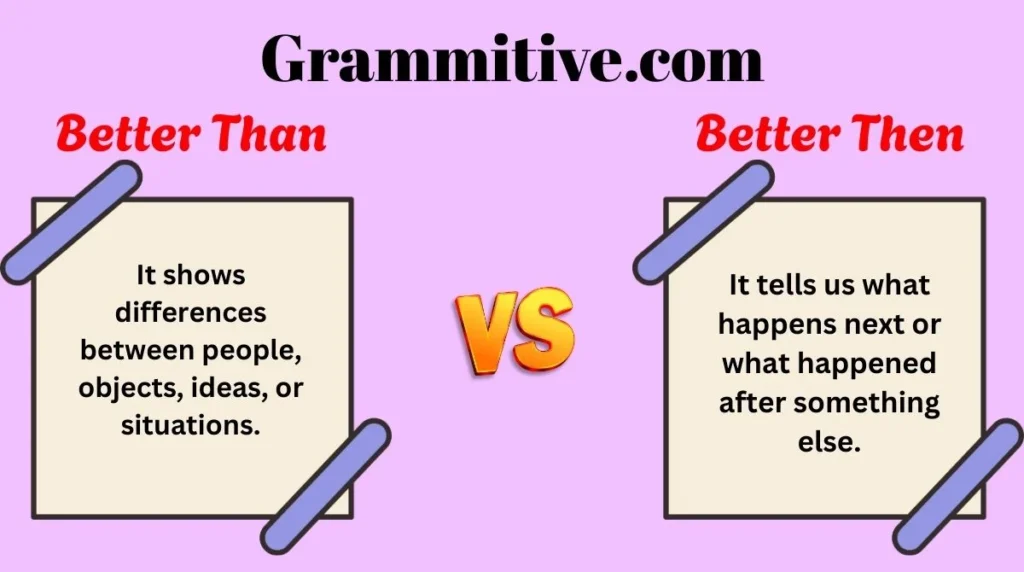
It shows differences between people, objects, ideas, or situations.
If you are choosing between A and B, you usually need than.
When to use “than”
Use than with:
- bigger than
- smaller than
- better than
- worse than
- faster than
- more than
- less than
It often comes after comparative adjectives (words ending in -er or using more/less).
Grammar rule
Comparative adjective + than + noun/pronoun
Example structure:
She is taller than me.
Example sentences (6–8)
- This cake tastes better than the last one.
- My house is bigger than yours.
- He runs faster than his brother.
- Math is easier than science for me.
- Today is colder than yesterday.
- I like tea more than coffee.
- This road is safer than the old one.
- Her job is more interesting than mine.
Common learner confusion
Many students accidentally write:
❌ better then
❌ bigger then
This happens because:
- “than” and “then” sound similar
- spell check sometimes misses it
- typing quickly causes mistakes
But remember: comparisons always need THAN.
What Does “Then” Mean?
Simple definition
Then is about time or order.
It tells us what happens next or what happened after something else.
Think of it as a timeline word.
When to use “then”
Use then for:
- next actions
- sequence of steps
- future plans
- past events
- results
It often means:
- after that
- at that time
- next
Grammar rule
Action 1 → then → Action 2
It connects events in order.
Example sentences (6–8)
- Finish your homework, then you can play.
- We ate dinner and then watched a movie.
- She was young then, only ten years old.
- First boil the water, then add the pasta.
- I will call you and then explain everything.
- Back then, life was simpler.
- He studied hard, then passed the exam.
- Let’s meet at 5, then go shopping.
Common learner confusion
Students often use then in comparisons because they focus on sound, not meaning:
❌ She is smarter then me.
But this sentence is not about time. It’s about comparison. So then is wrong.
Difference Between Than and Then (Detailed)
This is where everything becomes clear.
These words are not similar in meaning at all. They only sound alike.
Quick comparison table
| Feature | Than | Then |
|---|---|---|
| Meaning | Comparison | Time/order |
| Use | Compare two things | Show sequence |
| Grammar role | Conjunction | Adverb |
| Example | taller than me | eat, then sleep |
| Question to ask | “Which is better?” | “What happens next?” |
Usage difference
Than → difference between things
My car is faster than yours.
Two cars are compared.
Then → time or step
We washed the car, then drove home.
Two actions in order.
Grammar logic
Think of it this way:
- Comparison = than
- Timeline = then
Different jobs, different words.
Sentence structure difference
Than structure:
Comparative adjective + than + object
better than me
Then structure:
Clause + then + next action
eat dinner, then sleep
Meaning comparison
- Than answers: Which one is better?
- Then answers: What happens next?
That simple question can guide you every time.
Grammar Rules You Must Remember
Rule #1 – Use “than” after comparative adjectives
Correct:
✔ This movie is longer than the book.
Wrong:
❌ longer then
Rule #2 – Use “then” for steps or instructions
Correct:
✔ Wash your hands, then eat.
Wrong:
❌ wash your hands, than eat
Rule #3 – Never use “then” for comparisons
Correct:
✔ She is stronger than me.
Wrong:
❌ stronger then
Rule #4 – If you can replace the word with “after that,” use “then”
Example:
I finished work, then went home.
→ I finished work, after that went home.
Works perfectly. So “then” is correct.
Common Mistakes Students Make
Why mistakes happen
There are three main reasons:
- Similar pronunciation
- Fast typing
- Not checking meaning
Even native speakers sometimes make this mistake online.
Wrong vs correct examples
❌ This phone is better then mine.
✔ This phone is better than mine.
❌ Do your homework than sleep.
✔ Do your homework then sleep.
❌ She is older then her sister.
✔ She is older than her sister.
❌ We went home than cooked dinner.
✔ We went home then cooked dinner.
Easy correction tips
- Stop and ask: comparison or time?
- Read your sentence slowly
- Replace with “after that” to test
- Check every “then/than” while proofreading
Small check, big improvement.
Easy Trick to Remember the Difference
Here’s a simple classroom trick many students love.
The letter trick
Than = comparison → both have letter A
than
compare
Both have A.
So: comparison = than
Time trick
Then = time → both have letter E
then
time
Both have E.
So: time = then
This little letter trick works fast in exams or writing.
Students remember it for years.
Daily Life Examples (Very Important)
Now let’s see how people actually speak in daily life.
These are normal, natural sentences.
- This coffee is better than the one yesterday.
- Finish eating, then brush your teeth.
- My new job is easier than the old one.
- Call me first, then message Sarah.
- This road is safer than the highway.
- We bought tickets and then entered the theater.
- Her English is better than mine.
- Heat the oil, then add onions.
- Life feels better than last year.
- I’ll study now and then relax.
Notice how natural they sound when the right word is used.
Practice Section
Choose than or then.
Questions
- This test is easier ___ the last one.
- Eat dinner ___ do the dishes.
- My sister is taller ___ me.
- We finished work and ___ went home.
- This movie is more interesting ___ that one.
Answers
- than
- then
- than
- then
- than
If you got all correct, great job. If not, review the comparison vs time rule again.
FAQs
What is the difference between than and then?
Than compares two things.
Then shows time or order.
Comparison vs sequence — that’s the key difference.
Can we use “then” in comparisons?
No. Never.
Comparisons always use than.
Using “then” is a grammar mistake.
Is “than” formal or informal?
It works in both.
You use than in daily speech, emails, essays, and exams.
It’s a normal grammar word, not formal or casual.
Can “then” mean “at that time”?
Yes.
Example: I was a student back then.
Here it means “at that time in the past.”
Why do native speakers confuse them too?
Because they sound similar.
Fast typing also causes errors.
But in careful writing, the difference is clear.
How can I quickly check which one to use?
Ask yourself:
- comparing things → than
- showing next step → then
That quick question usually solves it.
Final Conclusion
Small words can cause big problems in English. Than and then are perfect examples. They look similar and sound similar, but their meanings are completely different.
One compares. The other shows time.
Once you focus on meaning instead of sound, the confusion disappears. Every time you write a sentence, pause for one second and ask yourself: Am I comparing something, or am I talking about what happens next? Your answer will guide you to the correct word.
Practice helps a lot. Read sentences, write your own examples, and notice these words in books, messages, and conversations. After some time, choosing the right one will feel natural.
Soon you won’t even think about it — you’ll just know.
Keep learning, keep practicing, and your English will get better than ever… and then you’ll feel more confident every day.

I am Lucas Bennett, a digital content creator passionate about social media trends and online growth strategies.
I share practical insights and guides to help users better understand and navigate the digital world.