

English spelling can feel unfair sometimes.
You learn one rule. Then suddenly, a word breaks it.
You see “benefited” in one book, but “benefitted” in another. Both look right. Both look wrong. Your brain freezes.
Many English learners ask the same question:
Which one should I use? How many T’s are correct?
This small spelling difference causes big confusion. It shows up in school essays, emails, exams, and even job applications. If you choose the wrong form, your writing might look less professional.
The problem becomes harder because both spellings actually exist. Yes — both are real English. That’s why spell check often doesn’t help.
But don’t worry.
By the end, you’ll clearly understand:
- What each spelling means
- Why the difference exists
- Which one Americans use
- Which one British English prefers
- Easy grammar rules
- Simple tricks to remember
- Real-life examples you can copy
After reading, you won’t hesitate again when writing this word.
What Does “Benefited” Mean?
Simple definition
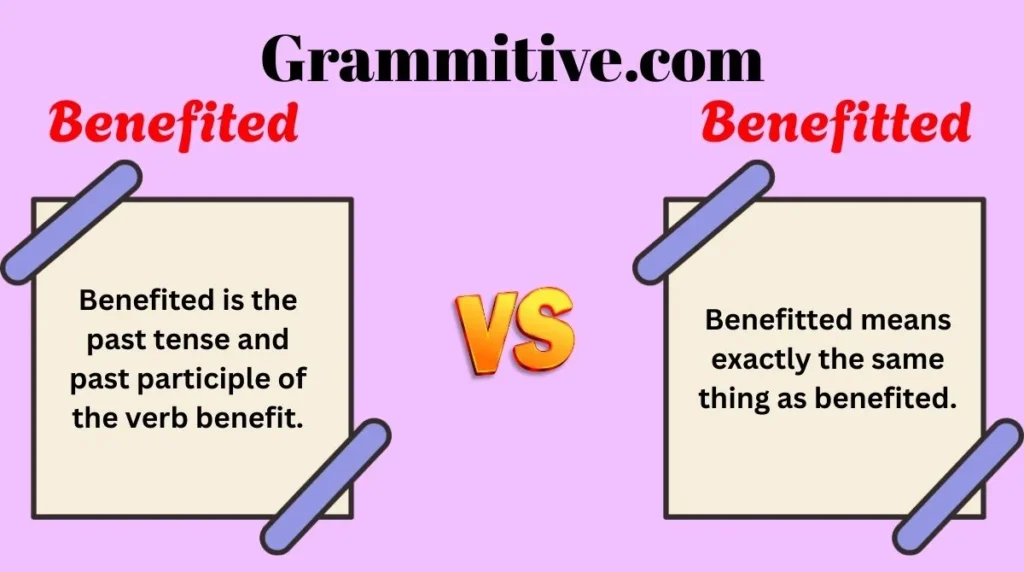
Benefited is the past tense and past participle of the verb benefit.
It means:
👉 received help, advantage, or good results from something
If something helps you or improves your life, you benefit from it.
When to use it
Use benefited when:
- Writing in American English
- Talking about the past
- Something helped someone
This is the most common spelling worldwide.
Grammar rule
Benefit → add -ed
No double T in American spelling.
This follows the normal pattern of many verbs:
- visit → visited
- open → opened
- benefit → benefited
Example sentences
- She benefited from the free English class.
- The company benefited from lower taxes.
- I benefited a lot from your advice.
- Students benefited from the new library.
- The city benefited after the park was built.
- We all benefited from teamwork.
- He benefited financially from the deal.
- The patient benefited from the treatment.
Common learner confusion
Many learners think:
“Because the word ends in T, maybe we must double it.”
But in American English, we do not double the T here.
That’s why benefited looks shorter and simpler.
What Does “Benefitted” Mean?
Simple definition
Benefitted means exactly the same thing as benefited.
Yes — same meaning.
It is just a different spelling style.
When to use it
Use benefitted when:
- Writing in British English
- Following UK spelling rules
- Your teacher or company prefers British spelling
British English often doubles the final consonant before adding -ed.
Grammar rule
In British English:
benefit → benefitted
The final t is doubled before adding -ed.
This follows British patterns like:
- travel → travelled
- cancel → cancelled
- benefit → benefitted
Example sentences
- She benefitted from extra practice.
- The team benefitted from better coaching.
- Local shops benefitted from tourism.
- He benefitted greatly from the scholarship.
- The village benefitted after the new road.
- We benefitted from their support.
- The country benefitted economically.
- Patients benefitted from the new system.
Common learner confusion
Students often think:
“These must have different meanings.”
But they don’t.
The only difference is regional spelling, not grammar or meaning.
Difference Between Benefited and Benefitted (Detailed)
Both words mean the same thing. The difference is spelling style.
Here is a simple comparison.
| Feature | Benefited | Benefitted |
|---|---|---|
| English type | American | British |
| Number of T’s | One | Two |
| Meaning | Same | Same |
| Grammar | Past tense | Past tense |
| Popularity | More common worldwide | Less common globally |
| Exams | TOEFL, SAT prefer this | IELTS (UK style) may accept |
Usage difference
If you are writing:
- For American readers → use benefited
- For British readers → use benefitted
Grammar logic
American English usually does not double consonants when the stress is not on the last syllable.
BEN-e-fit (stress on first syllable)
Because the stress is not on “fit,” Americans keep one T.
British English sometimes doubles anyway.
Sentence structure difference
There is no structure difference.
Both follow:
Subject + benefited/benefitted + from + noun
Example:
- She benefited from the class.
- She benefitted from the class.
Same grammar. Same meaning.
Meaning comparison
No difference at all.
Both mean:
- helped
- improved
- gained advantage
Grammar Rules You Must Remember
Rule #1 — American English uses one T
Benefit → benefited
Example:
I benefited from the course.
Rule #2 — British English often doubles the T
Benefit → benefitted
Example:
The town benefitted from tourism.
Rule #3 — Meaning never changes
Both spellings mean “received help.”
Example:
She benefited from therapy.
She benefitted from therapy.
Same meaning.
Rule #4 — Be consistent in one document
Do not mix both spellings.
❌ Wrong:
The company benefited and later benefitted.
✅ Correct:
The company benefited and later benefited.
Consistency makes your writing look professional.
Common Mistakes Students Make
Why mistakes happen
There are three big reasons:
- Spellings look similar
- Both exist in dictionaries
- American and British rules are different
So learners guess randomly.
Wrong vs correct examples
❌ I benefitted from the class. (American essay)
✅ I benefited from the class.
❌ She benefited greatly. (British exam that expects UK spelling)
✅ She benefitted greatly.
❌ They benefitteded from the help.
✅ They benefited from the help.
Easy correction tips
- Check your audience
- Pick one style
- Use spell check set to US or UK
- Remember: American = shorter spelling
Easy Trick to Remember the Difference
Here’s a simple memory trick students love.
Think:
America likes shorter words. Britain likes double letters.
Examples:
- traveled / travelled
- canceled / cancelled
- benefited / benefitted
So:
👉 One T → USA
👉 Two T’s → UK
Picture the British flag with “TT” on it. Silly, but easy to remember.
Your brain remembers funny things better.
Daily Life Examples (Very Important)
These sentences sound natural and spoken.
- I really benefited from your advice.
- She benefited a lot from online classes.
- We benefited from the discount.
- He benefited after changing jobs.
- My English benefited from daily practice.
- The kids benefited from healthy food.
- They benefited from moving to a bigger house.
- Our team benefited from better planning.
- I benefited just by listening.
- Everyone benefited in the end.
If you’re writing British English, simply double the T.

Practice Section
Choose the correct spelling.
Questions
- She ______ from the free course.
(benefited / benefitted) - The town ______ from tourism. (British English)
- We all ______ from your help.
- He ______ greatly from therapy. (American English)
- Students ______ from extra practice. (British English)
Answers
- benefited
- benefitted
- benefited
- benefited
- benefitted
FAQs
1. What is the difference between benefited and benefitted?
There is no meaning difference. Both mean “received help or advantage.” The only difference is spelling. American English uses one T, while British English often uses two.
2. Which spelling is more common worldwide?
Benefited is more common because American English is widely used online, in business, and in education. Many international learners prefer this form.
3. Can we use both spellings in one essay?
No. Choose one style and stay consistent. Mixing both looks like a mistake and may confuse readers.
4. Is benefitted wrong?
Not at all. It is correct in British English. It just looks unusual to American readers.
5. Can I use benefited in speaking?
Yes. Speaking doesn’t show spelling. Both sound exactly the same. This issue only matters in writing.
6. Which spelling should students use in exams?
Check the exam type.
TOEFL/SAT → benefited
IELTS (UK style) → benefitted or benefited
When unsure, benefited is usually safer.
Final Conclusion
Small spelling differences can cause big stress, especially for English learners. Seeing two correct versions of the same word makes anyone doubt themselves. But now the mystery is gone.
Both spellings mean the same thing. The only real difference is region.
American English prefers benefited with one T.
British English often uses benefitted with two T’s.
That’s it.
No grammar change. No meaning change. Just style.
If you want the safest choice for international writing, use the shorter form. It’s more common and widely accepted. But if you follow British spelling, the double T is perfectly correct.
Practice writing sentences. Notice the pattern in other words like traveled or cancelled. Soon, this rule will feel natural.
English becomes easier step by step.
Keep going — your writing keeps improving every day.

I am Lucas Bennett, a digital content creator passionate about social media trends and online growth strategies.
I share practical insights and guides to help users better understand and navigate the digital world.