
English has many small phrases that look similar but feel confusing. “Based on” and “based off of” are a perfect example.
You may hear both in movies, TV shows, YouTube videos, or everyday conversation. Native speakers use both. So naturally, learners start to wonder:
- Which one is correct?
- Are they the same?
- Is one formal and the other informal?
- Will teachers mark one wrong?
That confusion is normal.
Many students think these two phrases have different meanings. Others feel afraid to use either one because they don’t want to sound incorrect.
And sometimes grammar books say one thing, while real-life English sounds different.
The truth is simpler than you think.
Both phrases talk about the source or foundation of something. But one is more standard and grammatically preferred, especially in writing and formal English.
After reading this guide, you will clearly understand:
- What each phrase really means
- When to use each one
- Which one teachers and exams prefer
- How native speakers use them in daily life
- Easy tricks to remember the difference
By the end, you won’t hesitate anymore. You’ll choose the right phrase naturally and confidently.
What Does “Based On” Mean?
Simple meaning
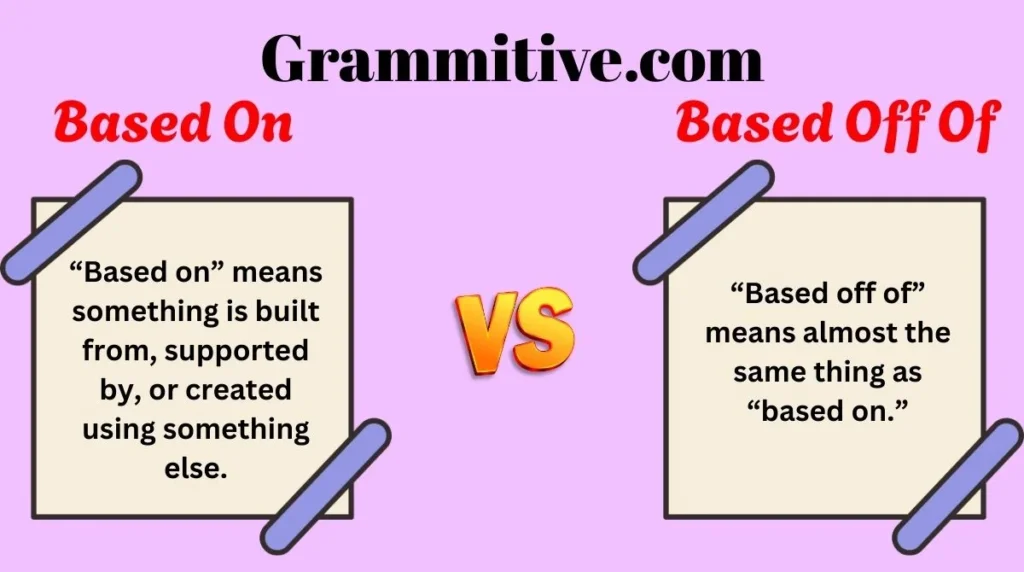
“Based on” means something is built from, supported by, or created using something else.
Think of it like a foundation.
Just like a house is based on the ground, an idea is based on facts.
When to use it
Use based on when you talk about:
- facts
- information
- research
- evidence
- true stories
- data
- experiences
It is the standard, correct, and formal phrase. Teachers, exams, books, and professional writing prefer this form.
Grammar rule
Structure:
Something + is/was + based on + noun/idea
Examples:
- The movie is based on a novel.
- Our decision is based on data.
Example sentences (6–8)
- The movie is based on a true story.
- His opinion is based on facts.
- This recipe is based on my grandmother’s cooking.
- The report is based on recent research.
- Our plan is based on customer feedback.
- The game is based on history.
- Her answer was based on logic.
- The design is based on nature.
Common learner confusion
Many students think “based on” must always be followed by a person. That’s not true. It can follow any idea or thing.
Wrong thinking:
❌ Based on John
Better:
✔ Based on John’s advice
✔ Based on John’s research
You need something that works as a foundation, not just a name.
What Does “Based Off Of” Mean?
Simple meaning
“Based off of” means almost the same thing as “based on.”
It also talks about a starting point or source.
But there’s a small difference in style, not meaning.
When to use it
You will hear based off of mostly in:
- casual speech
- American English
- everyday conversation
- social media
It sounds informal and conversational.
Teachers usually don’t recommend it for formal writing.
Grammar rule
Structure:
Something + is/was + based off of + noun/idea
Same structure. Only the preposition changes.
Example sentences (6–8)
- This app is based off of an old game.
- The show is based off of real events.
- His design is based off of street art.
- That joke was based off of a meme.
- The story is based off of my life.
- The plan is based off of last year’s results.
- The dance move is based off of hip-hop culture.
- The costume was based off of a superhero.
Common learner confusion
Some learners think “off of” sounds longer, so it must be more correct.
Actually, it’s the opposite.
In formal English, shorter is often better. “Based on” is cleaner and more traditional.
So:
Formal writing → based on
Casual speech → based off of (okay, but optional)
Difference Between Based On and Based Off Of (Detailed)
At first, these phrases feel identical. But their tone, style, and acceptance level are different.
Quick comparison table
| Feature | Based On | Based Off Of |
|---|---|---|
| Meaning | Foundation/source | Same meaning |
| Formality | Formal & standard | Informal |
| Writing | Preferred | Not recommended |
| Speech | Very common | Common in casual talk |
| Grammar books | Accept | Sometimes discouraged |
| Exams | Safe choice | Risky choice |
Usage difference
Based on sounds professional and correct everywhere.
Based off of sounds relaxed and spoken.
If you are writing:
- essay
- report
- exam answer
- academic paper
Use based on.
If you are chatting with friends, both are fine.
Grammar logic
Think about physical meaning.
“On” suggests support or foundation.
- A book is on the table
- A house is on the ground
So:
An idea is on facts
This feels natural.
“Off of” suggests movement away from something.
- Jump off the chair
- Take off your shoes
So grammatically, “off of” doesn’t feel as logical. That’s why traditional grammar prefers “on.”
Sentence structure difference
Structure is the same. Only tone changes.
Formal:
✔ The decision is based on research.
Informal:
✔ The decision is based off of research.
Meaning is equal. Style is different.
Meaning comparison
In modern English, the meaning difference is almost zero.
But historically:
- based on = foundation
- based off of = removed or copied from
Today, they blend together in speech.
Still, teachers prefer the older, cleaner version: based on.
Grammar Rules You Must Remember
Rule #1: Use “based on” in formal writing
✔ The report is based on data.
❌ The report is based off of data.
Rule #2: After “based,” use a noun or idea
✔ based on facts
✔ based on research
❌ based on think
❌ based on because
You need a noun phrase.
Rule #3: Avoid “off of” in exams
Examiners expect standard grammar.
✔ based on
Safer. Always.
Rule #4: Don’t add extra words
❌ based off of from
❌ based on from
Use only one preposition.
✔ based on
✔ based off of
Common Mistakes Students Make
Why mistakes happen
- They copy spoken English
- Movies use “off of”
- They think longer = better
- They translate from their native language
But grammar tests don’t follow casual speech.
Wrong vs correct examples
❌ The movie is based off of a true story. (formal essay)
✔ The movie is based on a true story.
❌ My answer is based off of because I feel so.
✔ My answer is based on facts.
❌ The game based on of history
✔ The game is based on history
Easy correction tips
Ask yourself:
“Am I writing something formal?”
If yes → use based on.
If talking casually → either is fine.
Easy Trick to Remember the Difference
Here’s a simple memory trick.
Picture a house.
A house stands on the ground, not off of the ground.
Ideas are like houses.
They stand on facts.
So:
Foundation → ON
That small picture helps many students remember forever.
Daily Life Examples (Very Important)
These sound natural in everyday speech.
- This movie is based on my favorite book.
- Our plan is based on last month’s sales.
- The teacher graded us based on effort.
- That recipe is based on Italian cooking.
- His story is based on real life.
- We chose the winner based on points.
- The app is based on user feedback.
- The design is based on nature.
- My guess was based on experience.
- The schedule is based on your availability.
You’ll notice most people naturally say “based on” even while speaking.
Practice Section
Choose the correct option.
Questions
- The movie is based ___ a true story.
- Our decision is based ___ research.
- The design is based ___ my old sketch.
- This report is based ___ facts.
- The game is based ___ a comic book.
Answers
- on
- on
- on
- on
- on
(Based on is always safer.)
FAQs
What is the difference between based on and based off of?
Both mean something comes from a source or foundation. “Based on” is formal and standard. “Based off of” is informal and more common in speech.
Which one is grammatically correct?
“Based on” is traditionally correct and accepted everywhere. Teachers and grammar books prefer it.
Can we use based off of in speaking?
Yes. Many native speakers use it casually. It sounds natural in conversation but not in formal writing.
Is based off of wrong?
Not exactly wrong. It’s just informal. Some teachers avoid it because it isn’t the classic form.
Can I use based on in questions?
Yes.
Examples:
- Is this based on facts?
- Was the movie based on a book?
Works perfectly.
Which should I use in exams or IELTS?
Always use “based on.” It’s safer and more professional.
Final Conclusion
Small grammar choices can make a big difference in how your English sounds. “Based on” and “based off of” share almost the same meaning, but they live in different worlds of style.
“Based on” is clean, correct, and trusted everywhere. It works in essays, exams, emails, and professional writing. You can use it without fear.
“Based off of” is relaxed and conversational. It’s fine with friends, but not ideal for formal situations.
If you ever feel unsure, choose “based on.” You will never be wrong.
Practice by making your own sentences every day. Talk about movies, plans, and decisions. The more you use the phrase, the more natural it feels.
Good grammar is not about memorizing rules. It’s about building small habits. And this one is easy.

I am Lucas Bennett, a digital content creator passionate about social media trends and online growth strategies.
I share practical insights and guides to help users better understand and navigate the digital world.