
English spelling can be tricky. Sometimes two or three words look almost the same but mean very different things. That’s exactly what happens with balk, baulk, and bulk.
Many learners mix them up because they sound similar when spoken. The spellings are also close.
Just one letter changes, but the meaning changes a lot. If you use the wrong one, your sentence can sound strange or even funny.
For example:
- “He bulked at the idea.” ❌
- “He balked at the idea.” ✅
See the problem? One small spelling mistake changes everything.
These words appear in books, news articles, sports, and daily conversations. So understanding them is very important.
If you’re preparing for exams, writing emails, or speaking English at work, you’ll need to know which word fits.
By the time you finish reading, you will clearly understand:
- what each word means
- when to use it
- how they are different
- easy tricks to remember them
- and how to avoid common mistakes
Think of this as a friendly classroom lesson. Slow, clear, and practical.
What Does “Balk” Mean?
Simple meaning
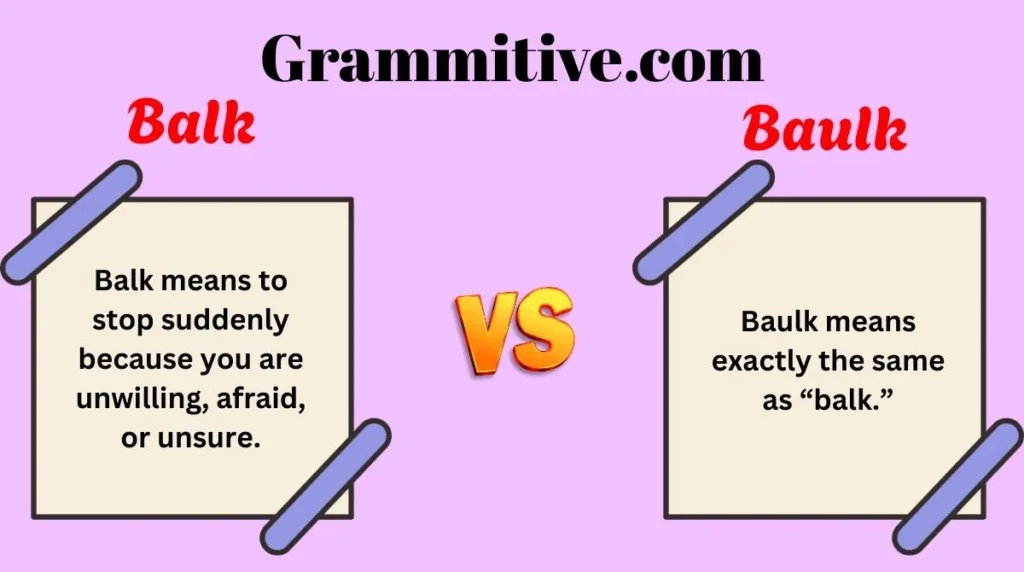
Balk means to stop suddenly because you are unwilling, afraid, or unsure.
It shows hesitation or refusal.
If someone balks, they don’t want to continue.
When to use it
Use balk when:
- someone refuses an idea
- someone hesitates
- someone pulls back from doing something
- a plan stops because of fear or doubt
It often talks about people’s reactions, not physical objects.
Grammar rule
Balk is usually:
- a verb (most common)
- sometimes a noun (less common)
Forms:
- balk
- balks
- balked
- balking
Common structure:
👉 balk at + noun/idea
Example: She balked at the price.
Example sentences
- He balked at paying $500 for the shoes.
- The horse balked before the jump.
- She balked at the idea of moving abroad.
- They balked when they heard the risk.
- I balked at speaking in front of the crowd.
- The team balked at the new rules.
- My parents balked at my late-night plan.
- Investors balked at the high cost.
Common learner confusion
Many students think balk = bulk because of sound.
But remember:
❌ balk = size
✅ balk = hesitation
If fear or refusal is involved, choose balk.
What Does “Baulk” Mean?
Simple meaning
Baulk means exactly the same as “balk.”
Yes — same meaning.
So why two spellings?
Because:
- Balk → American English
- Baulk → British English
It’s just a spelling difference, like:
- color / colour
- center / centre
- defense / defence
When to use it
Use baulk if:
- you are writing British English
- your audience is in the UK, Australia, or similar regions
Otherwise, Americans usually write balk.
Grammar rule
Same grammar as balk.
Forms:
- baulk
- baulks
- baulked
- baulking
Structure:
👉 baulk at + noun/idea
Example sentences
- She baulked at the expensive hotel bill.
- He baulked at jumping into the cold water.
- The company baulked at the new taxes.
- They baulked at signing the contract.
- I baulked at the thought of surgery.
- Many people baulk at public speaking.
- The player baulked before the shot.
- The workers baulked at overtime hours.
Common learner confusion
Students often think:
“Baulk looks strange. Maybe it’s wrong.”
It’s not wrong — just British spelling.
If you’re taking IELTS or studying British English, baulk is perfectly correct.
Difference Between Balk and Baulk (Detailed)
Here’s the good news.
There is no meaning difference at all.
Only spelling changes.
Quick comparison table
| Feature | Balk | Baulk |
|---|---|---|
| Meaning | hesitate/refuse | hesitate/refuse |
| Type | verb/noun | verb/noun |
| English style | American | British |
| Pronunciation | same | same |
| Usage | USA, Canada | UK, Australia |
Usage difference
- Writing for Americans → balk
- Writing for British readers → baulk
Grammar logic
Both follow the same patterns:
- balk/baulk at something
- balked/baulked
- balking/baulking
Sentence structure difference
There is none.
Compare:
- She balked at the cost.
- She baulked at the cost.
Same structure. Same meaning.
Meaning comparison
Both show:
- fear
- refusal
- hesitation
- unwillingness
So you can treat them as twins.
What Does “Bulk” Mean?
Now comes the tricky one.
Simple meaning
Bulk means size, volume, or large quantity.
It talks about amount, not hesitation.
Very different from balk/baulk.
When to use it
Use bulk when talking about:
- something big
- large size
- large quantity
- the main part of something
Grammar rule
Bulk is mostly a noun, but sometimes a verb.
Forms:
- bulk (noun)
- bulk up (verb phrase)
- bulky (adjective)
Example sentences
- The bulk of the work is finished.
- She bought rice in bulk.
- The bulk of the crowd left early.
- The box has too much bulk.
- He tried to bulk up at the gym.
- Most of the bulk is water.
- Buying in bulk saves money.
- The bag’s bulk makes it hard to carry.
Common learner confusion
Many students accidentally write:
❌ I bulked at the price.
✅ I balked at the price.
Because bulk has nothing to do with hesitation.
It only talks about size or amount.
Grammar Rules You Must Remember
Rule #1 — Use balk/baulk for hesitation
✔ She balked at the offer.
❌ She bulked at the offer.
Rule #2 — Use bulk for size or quantity
✔ The bulk of the cake is gone.
❌ The balk of the cake is gone.
Rule #3 — Choose spelling by region
✔ US English → balk
✔ UK English → baulk
Example:
British essay → “He baulked at the idea.”
Rule #4 — “Bulk” often follows “the” or “in”
✔ the bulk of
✔ in bulk
Example: They buy vegetables in bulk.
Common Mistakes Students Make
Why mistakes happen
- similar pronunciation
- very similar spelling
- fast typing
- spell-check confusion
Wrong vs correct examples
❌ I bulked at speaking English.
✔ I balked at speaking English.
❌ She baulked rice in bulk.
✔ She bought rice in bulk.
❌ The balk of the building is concrete.
✔ The bulk of the building is concrete.
Easy correction tips
Ask yourself:
👉 “Am I talking about fear or size?”
- fear → balk/baulk
- size → bulk
This question fixes 90% of errors.
Easy Trick to Remember the Difference
Here’s a simple memory trick.
Trick 1
Balk = Block
When you balk, you block yourself.
Both start with B + L sound.
Block → stop
Balk → stop
Trick 2
Bulk = Big
Both start with B and mean something large.
Bulk → big size
Real-life logic
If you hesitate at the price, that’s emotional → balk.
If you buy 20 boxes together, that’s quantity → bulk.
Emotion vs size. Easy.
Daily Life Examples (Spoken English)
These are the kinds of sentences you hear every day.
- I balked at paying that much rent.
- She baulked at the scary movie.
- We buy paper towels in bulk.
- He balked when the boss asked for overtime.
- They ordered food in bulk for the party.
- I baulked at jumping into the cold pool.
- The bulk of the class passed the test.
- She balked at the long drive.
- Buying in bulk saves money.
- He balked at the idea of quitting his job.
Notice how natural they sound.
Practice Section
Choose the correct word: balk / baulk / bulk
Questions
- She ______ at the high ticket price.
- We buy coffee beans in ______.
- He ______ at signing the risky deal.
- The ______ of the work is finished.
- The horse ______ before the jump.
Answers
- balked/baulked
- bulk
- balked/baulked
- bulk
- balked/baulked
FAQs
What is the difference between balk and baulk?
They have the same meaning. The only difference is spelling. Balk is American English. Baulk is British English.
What is the difference between balk and bulk?
Balk means hesitate or refuse. Bulk means size or quantity. They are completely different in meaning.
Can we use balk in questions?
Yes. Example: “Did you balk at the price?” It works like any regular verb.
Is bulk formal or informal?
It works in both. You can use it in business writing, shopping talk, or everyday speech.
Which spelling should I use for exams?
Use the spelling style your exam follows. TOEFL → balk. IELTS → usually baulk, but both are often accepted.
Is balk common in daily conversation?
Yes. People use it often when talking about costs, risks, or fear of doing something.
Final Conclusion
Small spelling changes can create big confusion in English. These three words are a perfect example. Balk and baulk talk about hesitation or refusal.
They show emotion. The only difference between them is American or British spelling. On the other hand, bulk talks about size or quantity. It has nothing to do with fear or doubt.
When choosing the right word, just ask yourself one simple question: “Is this about feeling unsure or about size?” That quick check makes the answer clear.
Keep practicing with real sentences. Listen for these words in movies and conversations. The more you see them, the more natural they feel. Soon, you won’t even think twice before choosing the correct one.
Language becomes easier step by step. And you’re already on the right path.

I am Lucas Bennett, a digital content creator passionate about social media trends and online growth strategies.
I share practical insights and guides to help users better understand and navigate the digital world.