

Many English learners mix up small words that look or sound similar. Words like attend and tend often cause this problem.
They look almost the same. They even share some letters. So it’s easy to think they mean the same thing.
But they don’t.
These two words are used in very different ways in daily English. One talks about going somewhere or being present. The other talks about caring for something or something happening often. If you choose the wrong one, your sentence can sound strange or even confusing.
Imagine saying, “I tend the meeting yesterday.” That sounds odd, right? Native speakers would immediately notice something is wrong.
This topic matters more than you think. You hear these words at school, at work, in hospitals, in news reports, and in everyday conversation.
If you use them correctly, your English will sound clear and natural. If you mix them up, people may not understand you.
After reading this guide, you’ll clearly know:
- what attend means
- what tend means
- when to use each one
- simple grammar rules
- easy memory tricks
- real-life examples
By the end, choosing the right word will feel easy and automatic.
What Does “Attend” Mean?
Simple meaning
Attend means to go to something, be present, or take part in an event or activity.
Think of it as:
👉 show up + be there
When to use it
Use attend for:
- meetings
- classes
- school
- events
- weddings
- conferences
- appointments
It often talks about physical presence.
Grammar rule
Attend + noun (event/place/activity)
No preposition is needed.
✅ attend school
❌ attend to school
❌ attend at school
Examples
- I attend school every day.
- She attended the meeting yesterday.
- We will attend the wedding next week.
- He attends church on Sundays.
- They attended a training session.
- Many people attended the concert.
- Did you attend the class today?
- She couldn’t attend the interview.
Common learner confusion
Many students add “to” after attend.
Wrong: I attended to the party.
Correct: I attended the party.
Remember: No “to” needed.
What Does “Tend” Mean?
Simple meaning
Tend has two main meanings:
- To take care of something or someone
- To usually happen or often do something
So it’s about care or habit.
When to use it
Use tend when you talk about:
- caring for plants, animals, people
- natural behavior or habits
- things that happen often
Grammar rule
Two common structures:
tend to + verb (base form)
tend + noun (care for something)
Examples
- She tends to wake up early.
- I tend to forget names.
- Nurses tend to patients in the hospital.
- He tends the garden every morning.
- Kids tend to get tired after school.
- Cats tend to sleep a lot.
- Farmers tend their crops carefully.
- I tend to drink coffee at night.
Common learner confusion
Some learners think tend means “go to an event.”
Wrong: I tend the meeting.
Correct: I attend the meeting.
Remember: tend ≠ go somewhere
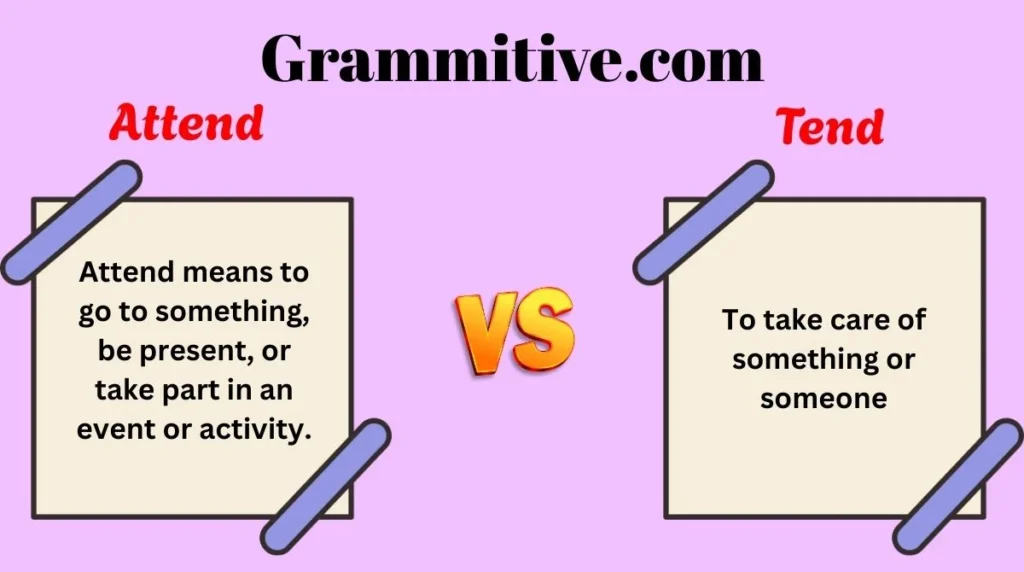
Difference Between Attend and Tend (Detailed)
These words may look similar, but their meanings are very different. Understanding the logic makes everything easier.
Quick comparison table
| Feature | Attend | Tend |
|---|---|---|
| Main idea | Be present | Care or usually do |
| Use for events | Yes | No |
| Use for habits | No | Yes |
| Use for care | Rarely | Yes |
| Structure | attend + noun | tend to + verb / tend + noun |
| Example | attend a class | tend to forget |
Usage difference
Attend → location or event
You physically go somewhere.
Tend → behavior or care
You describe a habit or responsibility.
Grammar logic
With attend, the action goes directly to the event:
attend + meeting
attend + school
With tend, you usually need to + verb:
tend to sleep
tend to worry
Or a noun when caring:
tend the garden
Sentence structure difference
Attend:
- I attend the workshop.
Tend:
- I tend to arrive late.
- I tend the plants.
Different grammar. Different meaning.
Meaning comparison
- Attend = show up
- Tend = look after / usually do
Once you understand this simple idea, the confusion disappears.
Grammar Rules You Must Remember
Rule #1 — Attend does NOT use “to”
Wrong: attend to the class
Correct: attend the class
Example:
I attend English class every day.
Rule #2 — Tend for habits needs “to + verb”
Wrong: I tend sleep late
Correct: I tend to sleep late
Example:
She tends to worry too much.
Rule #3 — Tend for care uses a noun directly
Example:
He tends the sheep.
She tends the baby.
No “to” here.
Rule #4 — Attend usually refers to planned events
Example:
We attended the conference.
You don’t attend random daily actions. You attend organized things.
Common Mistakes Students Make
Why mistakes happen
- Words look similar
- Same letters
- Both are verbs
- Translation from native language causes confusion
Let’s fix them.
Mistake 1
❌ I tend the meeting yesterday.
✅ I attended the meeting yesterday.
Tip: meetings = attend
Mistake 2
❌ I attend to wake up early.
✅ I tend to wake up early.
Tip: habits = tend
Mistake 3
❌ She attended the garden.
✅ She tends the garden.
Tip: care = tend
Mistake 4
❌ He tends school every day.
✅ He attends school every day.
Tip: school = attend
Easy correction tips
Ask yourself:
- Am I going somewhere? → attend
- Is it a habit or care? → tend
This simple question solves most problems.
Easy Trick to Remember the Difference
Here’s a simple memory trick students love.
Attend = At + End
Picture yourself at the event until it ends.
You are physically there.
Attend → be there
Tend = Take care
Both start with T.
Tend → Take care
Also:
“I tend to…” sounds like “usually.”
So:
- tend = care or usual action
This logic sticks in your brain easily.

Daily Life Examples (Spoken English)
These sound natural in real conversations.
- I can’t attend the party tonight.
- She attended all her classes this week.
- We attended my cousin’s wedding.
- He tends to talk too fast.
- I tend to eat late at night.
- The nurse tends the patients gently.
- Kids tend to get bored quickly.
- Did you attend the meeting yesterday?
- Farmers tend their animals every morning.
- I tend to forget my keys.
Notice how different they feel.
Practice Section
Choose attend or tend.
- I will ______ the conference tomorrow.
- She ______ to worry too much.
- They ______ the sick dog carefully.
- We couldn’t ______ the wedding.
- Kids ______ to copy their parents.
Answers
- attend
- tends
- tend
- attend
- tend
FAQs
1. What is the difference between attend and tend?
Attend means to be present at an event or place. Tend means to care for something or usually do something. One is about location, the other about habit or care.
2. Can we use attend in questions?
Yes. It works like any regular verb.
Example: Did you attend the class today?
3. Is tend formal or informal?
Tend is neutral. You can use it in both casual speech and formal writing. It sounds natural in everyday English.
4. Do we say attend to something?
Yes, but it has a different meaning. “Attend to” means deal with or take care of. Example: The nurse will attend to the patient. This is less common for beginners.
5. Can tend mean “usually”?
Yes. “Tend to” often shows habit or typical behavior.
Example: I tend to sleep late on weekends.
6. Which word is used for school or meetings?
Always use attend for school, meetings, events, and ceremonies.
Final Conclusion
Small words can create big confusion in English. Attend and tend look similar, but their meanings are very different.
Remember the simple ideas:
Attend → go somewhere, be present
Tend → care for something or usually do something
If you think about the action first, choosing becomes easy. Are you showing up at an event? Use attend. Are you talking about a habit or taking care of something? Use tend.
Try using both words in your daily speaking and writing. Make small sentences. Practice with friends. The more you use them, the more natural they will feel.
Soon, you won’t even have to think. Your brain will automatically pick the correct word — just like native speakers do.

I am Lucas Bennett, a digital content creator passionate about social media trends and online growth strategies.
I share practical insights and guides to help users better understand and navigate the digital world.