
Many English learners feel confused when they talk about work and location.
Should you say “I’m at the office” or “I’m in the office”?
Both sound correct. Both talk about the same place. Yet native speakers use them differently. That small change — at or in — can change the meaning of the sentence.
This is where many students feel unsure.
Some learners think the two phrases mean exactly the same thing. Others try to memorize long grammar rules and end up more confused.
Then, during conversation, they freeze and wonder which one sounds natural.
The truth is much simpler.
English prepositions like at and in often show different ideas about place. One talks about a general location.
The other talks about being inside something. Once you understand this basic idea, everything becomes easy.
By the end of this guide, you will clearly understand:
- when to use each phrase
- the real meaning behind both
- how native speakers use them in daily life
- common mistakes and how to avoid them
- simple tricks to remember forever
After that, choosing the right phrase will feel natural — not stressful.
What Does “At the Office” Mean?
Simple definition
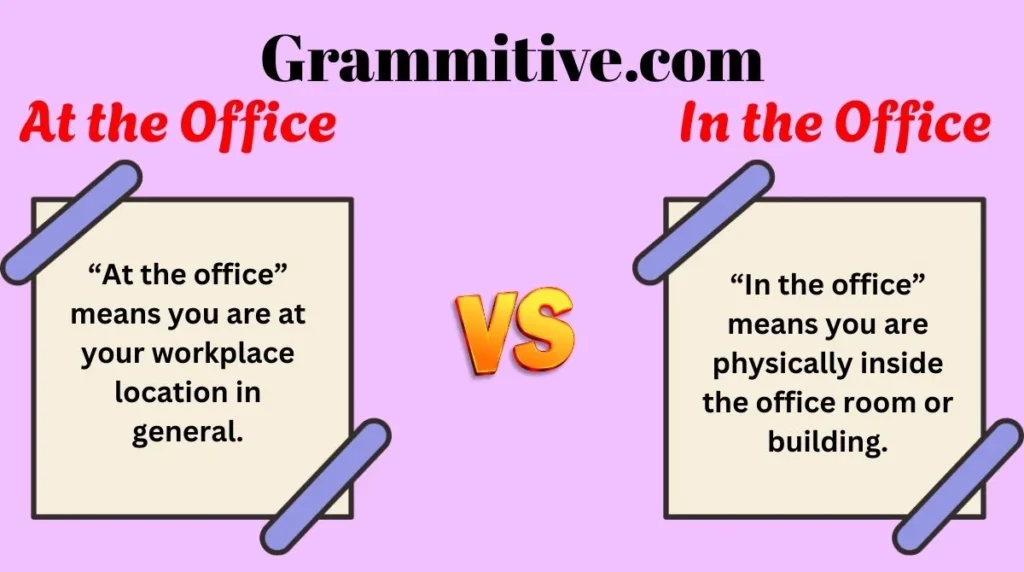
“At the office” means you are at your workplace location in general.
It does not focus on being inside the building. It only shows where you are.
Think of it like a point on the map.
You are there. That’s enough information.
When to use it
Use at the office when:
- talking about your location generally
- telling someone where you are
- focusing on work, not the building
- speaking casually or on the phone
Grammar rule
We use at for specific points or places:
- at school
- at home
- at the airport
- at the office
It answers the question: Where are you?
Examples
- I’m at the office right now.
- She’s at the office until 6 p.m.
- Call me when you get to the office.
- He stayed at the office late yesterday.
- They’re at the office for a meeting.
- I left my laptop at the office.
- Is the manager at the office today?
- We met at the office before lunch.
Notice something.
These sentences talk about work location, not the inside of the room.
Common learner confusion
Many students think:
❌ “At means outside only.”
That’s not true.
You can be inside the building and still say at the office.
Because the focus is location, not position.
So even if you are sitting at your desk inside, you can still say:
“I’m at the office.”
What Does “In the Office” Mean?
Simple definition
“In the office” means you are physically inside the office room or building.
Now the focus changes.
It’s about inside space.
Think of it like being inside a box.
When to use it
Use in the office when:
- talking about being inside the building
- describing physical position
- explaining where something is located
- contrasting inside vs outside
Grammar rule
We use in for inside spaces or areas:
- in the room
- in the house
- in the car
- in the office
It answers the question: Inside where?
Examples
- She is in the office working on reports.
- I left my phone in the office.
- The boss is in the office with a client.
- There are three people in the office now.
- We ate lunch in the office.
- He sleeps in the office during night shifts.
- It’s quiet in the office today.
- The printer is in the office near the window.
These sentences clearly show inside the space.
Common learner confusion
Some learners use in for everything:
❌ “I’ll call you when I’m in the office” (when they mean arriving at work)
Sometimes it sounds too specific.
Native speakers often prefer:
“I’ll call you when I’m at the office.”
Because they mean “when I reach work,” not “when I step inside the room.”
Difference Between At the Office and In the Office (Detailed)
Here is where everything becomes clear.
Quick comparison table
| Feature | At the office | In the office |
|---|---|---|
| Meaning | General location | Inside the building/room |
| Focus | Workplace | Physical position |
| Type | Point | Space |
| Common use | Daily speech | Descriptions |
| Example | I’m at the office | I’m in the office |
Usage difference
At = where you are generally
In = inside something
So:
- At → location
- In → position
Grammar logic
English prepositions follow a pattern:
- at → points (at work, at school, at home)
- in → containers/spaces (in a room, in a car, in a building)
An office is both:
✔ a workplace
✔ a room/building
That’s why both are possible.
Sentence structure difference
Compare:
- I’m at the office. (location fact)
- I’m in the office. (inside physically)
Subtle, but real.
Meaning comparison
Imagine your friend calls.
Friend: “Where are you?”
If you say:
👉 “I’m at the office.”
You mean: I’m at work.
If you say:
👉 “I’m in the office.”
You mean: I’m inside the office building, not outside or traveling.
Small difference. Big clarity.
Grammar Rules You Must Remember
Rule #1: Use “at” for general places
Use it for schools, offices, stations, work.
Example:
✔ She is at the office today.
Rule #2: Use “in” for inside spaces
If you can imagine walls around you, use in.
Example:
✔ He’s in the office near the window.
Rule #3: Use “at” when talking about work routine
Daily life → at
Example:
✔ I’m at the office from 9 to 5.
Rule #4: Use “in” when describing objects or people inside
Specific placement → in
Example:
✔ Your file is in the office drawer.
Common Mistakes Students Make
Why mistakes happen
Mostly because:
- many languages don’t use prepositions the same way
- both phrases look similar
- learners translate directly
Wrong vs correct examples
❌ I am in the office every day from 9 to 5.
✔ I am at the office every day from 9 to 5.
(Here we talk about routine, not inside position.)
❌ Call me when you arrive in the office.
✔ Call me when you arrive at the office.
(Arriving at a place → at)
❌ My bag is at the office desk.
✔ My bag is in the office on the desk.
(Object inside space → in)
Easy correction tips
Ask yourself:
👉 “Am I talking about location or inside position?”
If location → at
If inside → in
Simple.
Easy Trick to Remember the Difference
Here’s a small memory trick my students love.
Think like this:
- AT = A Tiny point
- IN = Inside
AT → point on a map
IN → inside a box
Picture Google Maps.
If you drop a pin → that’s AT
If you walk inside the building → that’s IN
This visual idea helps you choose quickly without thinking too hard.
Daily Life Examples (Very Important)
These sound natural in everyday speech.
- I’m at the office. I’ll call you later.
- She’s still at the office finishing her work.
- Are you at the office today or working from home?
- The lights are still on in the office.
- There’s nobody in the office right now.
- Let’s meet at the office tomorrow morning.
- I left my charger in the office drawer.
- He’s in the office talking to the boss.
- We’re at the office early today.
- It’s too hot in the office. Turn on the AC.
Notice how natural each sentence sounds.
Native speakers choose automatically based on meaning.
Practice Section
Choose at or in.
- I’m ___ the office right now.
- My keys are ___ the office desk.
- She works ___ the office every weekday.
- There are five people ___ the office.
- Let’s meet ___ the office at 10.
Answers
- at
- in
- at
- in
- at
FAQs
What is the difference between “at the office” and “in the office”?
“At” shows general location or workplace. “In” shows being physically inside the building or room. It’s about focus, not correctness.
Can we use both in the same situation?
Yes, sometimes both are possible. The meaning changes slightly. Native speakers choose based on what they want to emphasize.
Which one is more common in daily English?
“At the office” is more common when talking about work or routine. It sounds more natural in casual conversation.
Can I say “I’m in office”?
No. You need the article. Say “in the office.” Without “the,” it sounds incorrect.
Is “at the office” formal or informal?
It works in both formal and informal English. You can use it in emails, meetings, and daily speech.
What about “at work” vs “in the office”?
“At work” is even more general. It doesn’t mention the building. “In the office” is more specific and physical.
Final Conclusion
Prepositions look small, but they carry big meaning.
The difference between these two phrases is not about right or wrong. It’s about focus. One talks about your general workplace location. The other talks about being physically inside the space.
Remember the simple idea:
Location → at
Inside → in
Once this becomes clear, your sentences will sound natural and confident. No more second-guessing when someone calls and asks, “Where are you?”
Listen to native speakers. Practice with real-life sentences. Say them out loud. After a few days, your brain will choose automatically.
Small grammar points like this slowly build strong, fluent English. Keep practicing, and these tiny details will make a big difference in how natural you sound.

I am Lucas Bennett, a digital content creator passionate about social media trends and online growth strategies.
I share practical insights and guides to help users better understand and navigate the digital world.