
Some English words look almost the same but mean completely different things. These words can confuse even smart learners. One tiny spelling change can completely change the meaning of a sentence.
“Apposed” and “opposed” are a perfect example.
They look alike.
They sound a bit alike.
But they do not mean the same thing at all.
Because of this, many students mix them up when writing essays, emails, or exams. Some people even use one when they actually mean the other. That small mistake can make your sentence sound strange or incorrect.
You may have seen sentences like:
❌ I am apposed to this plan.
❌ The two magnets were opposed together.
Both are wrong. But why?
That’s exactly what you’re going to understand clearly here.
By the end, you will:
- know the meaning of each word
- understand when to use each one
- see many simple examples
- avoid common mistakes
- remember the difference easily
Everything is explained in plain, everyday English. No hard grammar terms. Just clear teaching, like in a friendly classroom.
What Does “Apposed” Mean?
Simple definition
Apposed means:
👉 placed next to something
👉 side by side
👉 touching or close together
It describes position, not opinion.
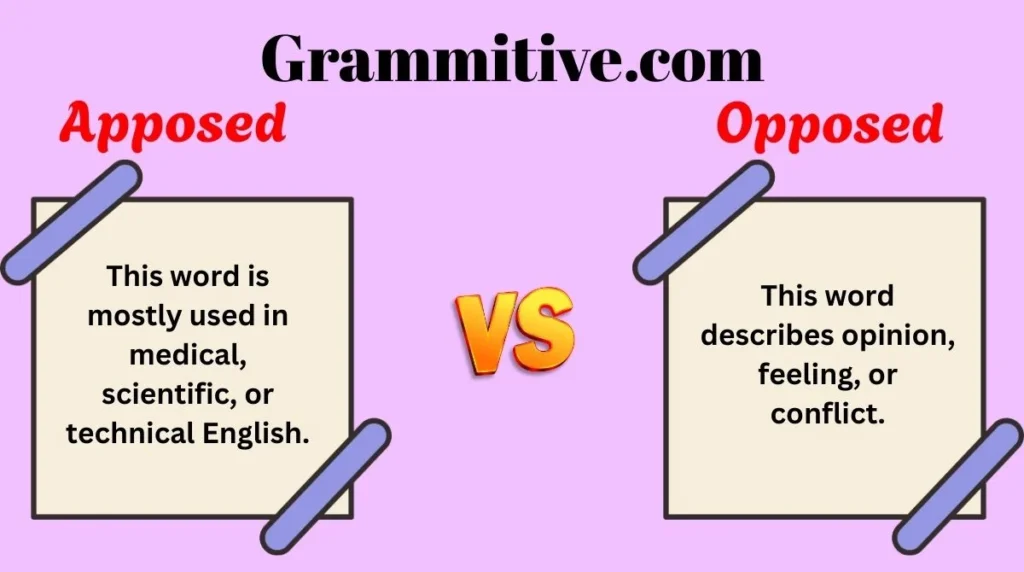
This word is mostly used in medical, scientific, or technical English. It is not very common in daily conversation.
When to use it
Use apposed when:
- two things are physically close
- two surfaces are touching
- parts are next to each other
It often appears in:
- medical reports
- biology
- anatomy
- engineering
Grammar rule
“Apposed” is usually:
- an adjective, or
- the past tense/past participle of appose
Structure:
- be + apposed
- apposed to
Examples:
- The skin edges were apposed.
- The two bones are apposed to each other.
Example sentences (easy ones)
- The two tiles were apposed neatly on the floor.
- The doctor apposed the edges of the wound.
- The leaves were apposed along the stem.
- The metal plates were apposed tightly.
- The papers lay apposed on the desk.
- The surgeon made sure the tissues were apposed.
- The bricks were apposed without gaps.
- The lips of the cut were carefully apposed.
Common learner confusion
Many students think apposed means “against” or “not agreeing.”
It does not.
It has nothing to do with disagreement.
It only talks about physical position.
Think: touching or side-by-side.
What Does “Opposed” Mean?
Simple definition
Opposed means:
👉 against something
👉 not agreeing
👉 fighting or resisting
This word describes opinion, feeling, or conflict.
It is very common in everyday English.
When to use it
Use opposed when:
- you disagree
- you are against an idea
- two sides fight or compete
- something moves in the opposite direction
It appears in:
- daily conversations
- news
- debates
- politics
- school essays
Grammar rule
“Opposed” is usually:
- an adjective
- or past tense of oppose
Common structures:
- be opposed to + noun/gerund
- oppose + noun
Examples:
- I am opposed to smoking.
- They opposed the plan.
Example sentences
- I am opposed to this rule.
- She opposed the new law.
- Many parents are opposed to longer school hours.
- The team opposed their rivals strongly.
- He is strongly opposed to violence.
- They opposed the decision in court.
- Two cars moved in opposed directions.
- She spoke against the plan because she was opposed.
Common learner confusion
Students sometimes spell opposed as apposed.
This is a spelling mistake.
If you mean:
- disagree
- against
- reject
Then you always need opposed, not apposed.
Difference Between Apposed and Opposed (Detailed)
These two words may look like twins, but their meanings are very far apart.
Quick comparison table
| Feature | Apposed | Opposed |
|---|---|---|
| Meaning | placed next to | against / disagreeing |
| Type | position | opinion/conflict |
| Common use | medical/scientific | everyday English |
| Frequency | rare | very common |
| Example | skin apposed | opposed to the plan |
Usage difference
Apposed → physical placement
It describes where something is.
- The edges are apposed.
Opposed → disagreement or resistance
It describes feelings or ideas.
- I am opposed to the idea.
Grammar logic
If your sentence talks about:
- touching
- being side by side
- physical closeness
Use apposed.
If it talks about:
- disagreement
- protest
- saying no
- fighting something
Use opposed.
Sentence structure difference
Apposed:
- X is apposed to Y
Opposed:
- X is opposed to Y
They look similar in grammar, but the meaning changes completely.
Compare:
- The bones are apposed. (touching)
- The bones are opposed. (fighting each other — strange!)
Meaning comparison
Think about this:
- Apposed = together
- Opposed = against
Together vs against.
Very different ideas.
Grammar Rules You Must Remember
Rule #1 — Use “opposed to” for disagreement
✔ I am opposed to cheating.
✔ They are opposed to the plan.
Never use “apposed” here.
Rule #2 — Use “apposed” only for physical position
✔ The edges were apposed.
✔ The surfaces were apposed tightly.
Not for opinions.
Rule #3 — “Oppose” is a common verb
✔ We oppose the decision.
✔ She opposed the change.
There is no common everyday verb use for “appose.”
Rule #4 — Check context first
Ask yourself:
👉 Is this about position or disagreement?
Position → apposed
Disagreement → opposed
Common Mistakes Students Make
These mistakes happen because the words look similar.
Your brain thinks they are the same. But they are not.
Mistake 1
❌ I am apposed to this idea.
✔ I am opposed to this idea.
Tip: opinions always use opposed.
Mistake 2
❌ The doctor opposed the skin edges.
✔ The doctor apposed the skin edges.
Tip: touching/closing wounds → apposed.
Mistake 3
❌ She is apposed to smoking.
✔ She is opposed to smoking.
Remember: lifestyle choices = opposed.
Easy correction tips
- If it sounds like an argument → opposed
- If it sounds like touching → apposed
- 95% of daily sentences use opposed
Easy Trick to Remember the Difference
Here’s a simple memory trick my students love.
Look at the first letter
A in apposed = alongside
Both start with A.
Apposed → alongside → next to
O in opposed = object
When you object to something, you disagree.
Opposed → object → against
This small trick helps you remember fast during exams or writing.
Daily Life Examples (Very Important)
These are sentences you might actually say in real life.
Notice that almost all use opposed.
- I’m opposed to waking up early on Sundays.
- My parents are opposed to junk food.
- She is opposed to working late.
- We opposed the price increase.
- He strongly opposed the change.
- The two teams opposed each other in the final match.
- Many people are opposed to noise at night.
- The workers opposed the new rules.
- I’m not opposed to helping you.
- They opposed building a factory near the school.
See? These are everyday ideas. That’s why “opposed” is much more common.
“Apposed” rarely appears in daily conversation unless you work in medicine or science.
Practice Section
Choose the correct word: apposed or opposed
Questions
- I am ______ to the new policy.
- The skin edges were carefully ______.
- She ______ the decision strongly.
- The magnets were ______ side by side.
- They are ______ to animal cruelty.
Answers
- opposed
- apposed
- opposed
- apposed
- opposed
FAQs
1. What is the difference between apposed and opposed?
Apposed means placed next to or touching. Opposed means against or disagreeing. One is about position, the other about opinion.
2. Can we use apposed in daily conversation?
Usually no. It is mostly used in medical or scientific writing. In daily life, you will rarely need it.
3. Is opposed formal or informal?
It works in both. You can use it in casual talk or formal writing. It’s very common in English.
4. Why do students confuse these two words?
Because they look almost the same in spelling and pronunciation. One extra “p” changes the meaning completely.
5. Can opposed be used as a verb?
Yes. Example: “They opposed the rule.” Here, it acts as a verb meaning “fought against.”
6. Which word is more common?
Opposed is much more common. Apposed is rare and mostly technical.
Final Conclusion
Small spelling differences can create big meaning changes in English. “Apposed” and “opposed” show this very clearly.
One talks about things being physically close or touching. The other talks about disagreement or resistance.
Most learners only need “opposed” in daily speaking and writing. “Apposed” appears mainly in medical or technical situations.
So if you feel unsure, check the meaning first. Ask yourself: Is this about position or disagreement?
That simple question will guide you every time.
Keep practicing with small sentences. Notice these words when reading books or watching the news. The more you see them, the easier they become.
Grammar doesn’t have to feel scary. With clear ideas and simple examples, everything starts to make sense.

I am Lucas Bennett, a digital content creator passionate about social media trends and online growth strategies.
I share practical insights and guides to help users better understand and navigate the digital world.