
Many English learners feel confused when they see sentences like:
- This rule is applicable to everyone.
- This discount is applicable for students.
Both sound correct. Both use the same word: applicable. But the small change — to or for — creates big confusion.
Students often ask, “Which one is right?” or “Can I use both?” Sometimes they copy what they hear without really understanding the reason. That’s when mistakes start happening.
Prepositions in English can be tricky. They don’t always follow logic. You cannot translate them directly from your language. So you need clear patterns and real examples.
This topic is very important in daily English. You see it in:
- rules and laws
- job descriptions
- school notices
- websites
- forms and instructions
If you choose the wrong preposition, your sentence may sound unnatural or slightly wrong to native speakers.
By the end, the difference will feel simple and natural. You’ll know:
- when to use applicable to
- when to use applicable for
- common mistakes to avoid
- easy memory tricks
- real-life spoken examples
Everything is explained in plain, friendly English, just like a classroom lesson.
What Does “Applicable” Mean?
Simple definition
Applicable means:
👉 able to be used, relevant, or suitable for a situation
In short:
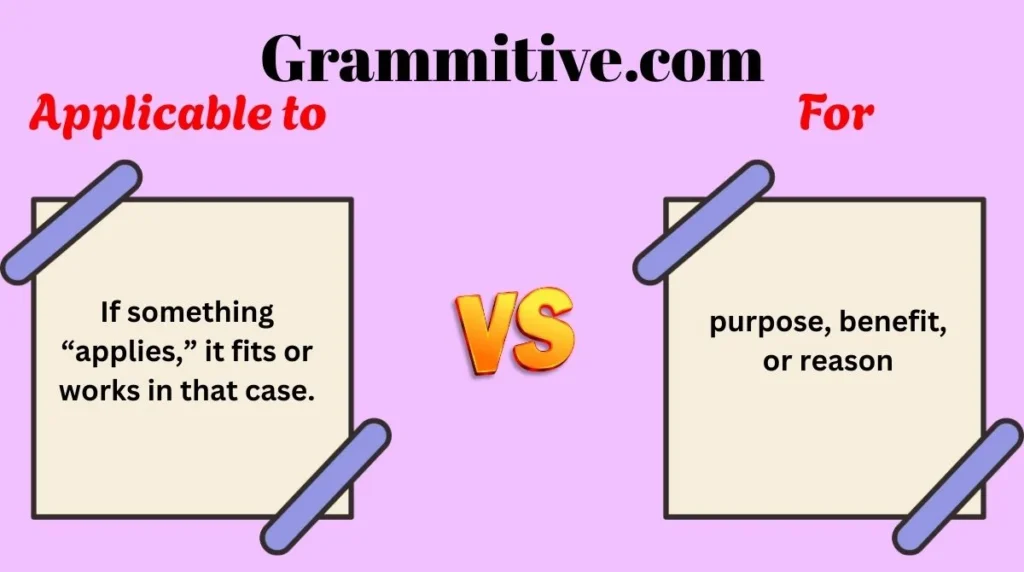
If something “applies,” it fits or works in that case.
When to use it
Use applicable when:
- a rule affects someone
- a law fits a situation
- a condition matches a case
- something is relevant or valid
Grammar rule
Basic structure:
applicable + preposition (to / for) + noun
Example:
- applicable to students
- applicable for members
The meaning changes slightly depending on the preposition.
Example sentences (general use)
- This rule is applicable to all employees.
- The policy is applicable during holidays.
- The discount is applicable to online orders only.
- This offer is not applicable on weekends.
- The tax is applicable to imported goods.
- The law is applicable nationwide.
- The condition is applicable in special cases.
- These instructions are applicable to beginners.
Common learner confusion
Many students think:
❌ applicable = for (always)
But that’s not correct.
Some sentences need to, not for.
Using the wrong one may sound strange or unnatural.
That’s why we must study each preposition separately.
What Does “To” Mean?
Simple definition
To often shows:
👉 direction, connection, or target
It answers:
- Who does it affect?
- What does it connect to?
When to use “to” with applicable
Use applicable to when something:
- affects someone or something
- relates directly to a group
- is valid for a specific case
- connects logically
Think: “applies to = affects”
Grammar rule
Structure:
applicable to + person / group / thing / situation
Example sentences
- This rule is applicable to all students.
- The tax is applicable to foreign buyers.
- The law applies to everyone.
- The policy is applicable to new employees only.
- This condition is applicable to children under 10.
- The changes are applicable to next year’s exam.
- The fee is applicable to each member.
- The warning is applicable to all drivers.
Common learner confusion
Students sometimes say:
❌ This rule is applicable for all students.
It sounds unnatural because we are talking about who the rule affects, not who benefits.
When we talk about target or connection, always use to.
What Does “For” Mean?
Simple definition
For often shows:
👉 purpose, benefit, or reason
It answers:
- Why?
- For whom?
- For what purpose?
When to use “for” with applicable
Use applicable for when something:
- is meant for a purpose
- is designed for a use
- is available for a group
- shows eligibility
Think: “for = purpose or benefit”
Grammar rule
Structure:
applicable for + use / purpose / benefit / situation
Example sentences
- This coupon is applicable for online shopping.
- The discount is applicable for students only.
- The card is applicable for travel expenses.
- The offer is applicable for first-time users.
- This ticket is applicable for one entry only.
- The grant is applicable for research projects.
- The pass is applicable for weekend travel.
- The scholarship is applicable for medical students.
Common learner confusion
Students use to here:
❌ The discount is applicable to students only.
This can be correct sometimes, but if you mean benefit or eligibility, for sounds more natural.
Small difference, big meaning.
Difference Between Applicable to and for (Detailed)
Here is the heart of the problem.
Both are correct English.
But they focus on different ideas.
Comparison Table
| Feature | Applicable to | Applicable for |
|---|---|---|
| Main idea | affects/relates | purpose/benefit |
| Focus | connection | use or eligibility |
| Common with | rules, laws, policies | offers, discounts, services |
| Sounds | formal/official | practical/benefit-based |
| Example | rule applies to staff | discount for staff |
Usage difference
Applicable to → who/what it affects
- rules
- laws
- policies
- conditions
Applicable for → what it is meant for
- discounts
- offers
- services
- benefits
Grammar logic
Think like this:
- “Does it affect someone?” → to
- “Is it meant for someone?” → for
Sentence structure difference
to structure:
- applicable to + people/things
for structure:
- applicable for + purpose/group/use
Meaning comparison
Compare:
- The rule is applicable to employees.
→ employees must follow it - The discount is applicable for employees.
→ employees can use it
See the difference?
One is about obligation.
The other is about benefit.
Grammar Rules You Must Remember
Rule #1 – Use “to” for rules and laws
This rule is applicable to all citizens.
Rules affect people. Not benefit them.
Rule #2 – Use “for” for benefits and offers
This discount is applicable for students.
Students receive something.
Rule #3 – If you can replace with “affects,” use “to”
The policy affects new workers.
→ applicable to new workers
Rule #4 – If you can replace with “meant for,” use “for”
The pass is meant for travel.
→ applicable for travel
Common Mistakes Students Make
Why mistakes happen
- Translating from native language
- Guessing randomly
- Not knowing the purpose difference
- Copying incorrect examples online
Wrong vs Correct
❌ This rule is applicable for everyone.
✅ This rule is applicable to everyone.
❌ The discount is applicable to students only.
✅ The discount is applicable for students only.
❌ The law is applicable for citizens.
✅ The law is applicable to citizens.
❌ This offer is applicable to new users.
✅ This offer is applicable for new users.
Easy correction tips
Ask yourself:
- Rule → to
- Benefit → for
It fixes 90% of mistakes.
Easy Trick to Remember the Difference
Here’s a simple classroom trick.
Think:
TO = touches
FOR = favor
If something touches or affects someone → TO
If something gives a favor/benefit → FOR
Examples:
- Rule touches you → to
- Discount favors you → for
Very easy. Students remember this quickly.
Daily Life Examples (Very Important)
These sound natural in daily conversation.
- Is this discount applicable for students?
- The rule is applicable to everyone here.
- This ticket is applicable for today only.
- The tax is applicable to foreign buyers.
- That offer isn’t applicable for online orders.
- The new policy is applicable to all staff.
- This coupon is applicable for food items only.
- The law applies to every driver.
- The warranty is applicable for one year.
- These instructions are applicable to beginners.
You can hear sentences like these in shops, offices, and schools.
Practice Section
Choose to or for.
- This rule is applicable ___ all members.
- The discount is applicable ___ students.
- The policy is applicable ___ new employees.
- This coupon is applicable ___ online shopping.
- The law is applicable ___ everyone.
Answers
- to
- for
- to
- for
- to
FAQs (SEO Focused)
1. What is the difference between applicable to and applicable for?
“Applicable to” shows something affects or relates to a group. “Applicable for” shows something is meant for a purpose or benefit. The focus changes from connection to use.
2. Can we use both in the same sentence?
Usually no. You choose one depending on meaning. Using both may sound confusing unless they describe different ideas in the sentence.
3. Is “applicable to” more formal?
Yes. It often appears in official documents, laws, and policies. It sounds more formal and technical than “for.”
4. Is “applicable for” common in spoken English?
Yes. It’s very common when talking about discounts, offers, and benefits in daily conversations.
5. Can I replace “applicable” with “apply”?
Yes. You can say “This rule applies to everyone.” The meaning stays the same and sounds more natural in speech.
6. Which one is safer to use in exams?
If unsure, remember: rules and laws → to. Benefits and offers → for. Following this rule works most of the time.
Final Conclusion
Small prepositions can create big problems in English. “Applicable to” and “applicable for” look almost the same, but their meanings are slightly different.
One talks about connection or effect. The other talks about purpose or benefit.
Once you see that difference, everything becomes easier. Just ask a simple question: Does it affect someone or help someone?
If it affects, choose to.
If it helps or is meant for someone, choose for.
Read examples. Listen to real English. Practice writing your own sentences. Soon, you won’t need to think twice.
Good grammar isn’t about memorizing rules. It’s about noticing patterns. And this is one pattern that becomes natural very quickly.
Keep practicing, and these small words will feel simple and friendly instead of scary.

I am Lucas Bennett, a digital content creator passionate about social media trends and online growth strategies.
I share practical insights and guides to help users better understand and navigate the digital world.