

English has many small words that look simple but cause big confusion.
“Anyplace” and “any place” are perfect examples.
At first, they look almost the same. The spelling is nearly identical. Many learners think they mean exactly the same thing.
Some students even use them randomly without knowing the rule. Sometimes teachers correct them, but the explanation feels unclear.
So the confusion stays.
You might hear someone say:
- “You can sit anyplace.”
- “You can sit any place.”
Both sound correct. Both sound natural. So what’s the difference?
That’s where things get tricky.
Understanding these two forms matters because they appear often in daily English. You’ll see them in conversations, movies, emails, and even exams.
Using the wrong one doesn’t always break grammar, but it can sound odd or unnatural to native speakers.
Once you clearly understand how each form works, you’ll feel more confident speaking and writing. You’ll stop guessing. You’ll know exactly which one fits your sentence.
By the end, you’ll understand:
- the meaning of each form
- when to use each one
- grammar rules
- common mistakes
- easy memory tricks
- real-life examples
Everything explained in plain, simple English — just like a classroom lesson.
What Does “Anyplace” Mean?
Simple meaning
“Anyplace” means “anywhere.”
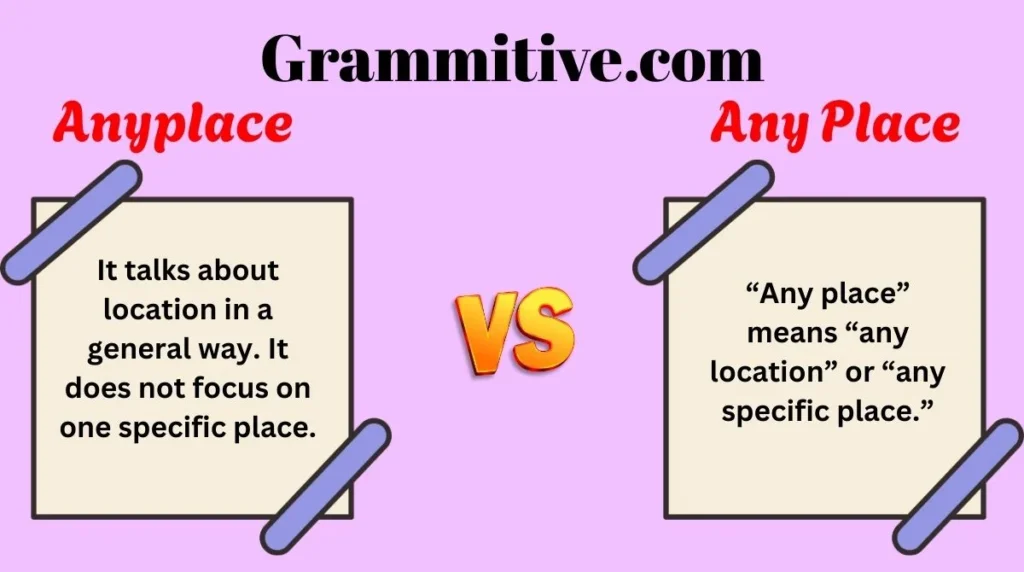
It talks about location in a general way. It does not focus on one specific place.
Think of it like this:
👉 anyplace = anywhere at all
It’s an adverb, not a noun phrase.
When to use it
Use anyplace when you mean:
- anywhere
- no specific location
- any location is okay
It is common in informal American English. You will hear it in speech more than formal writing.
Grammar rule
Because “anyplace” acts like anywhere, it usually:
- modifies verbs
- answers “where?”
- does NOT come before a noun
So you don’t say:
❌ anyplace store
Because it is not describing a noun.
Example sentences
Here are some clear examples:
- You can sit anyplace.
- I can’t find my keys anyplace.
- Let’s go anyplace quiet.
- She didn’t want to go anyplace alone.
- We searched anyplace we could think of.
- Is there anyplace to park?
- He never travels anyplace far.
- I don’t want to live anyplace else.
Notice something?
In all sentences, it replaces “anywhere.”
Common learner confusion
Students often think:
“Anyplace = any place. Same thing.”
But grammar says they behave differently.
Many learners also try:
❌ anyplace restaurant
❌ anyplace city
This is wrong because anyplace is not an adjective. It cannot describe a noun.
That mistake happens when people forget it works like an adverb.
What Does “Any Place” Mean?
Simple meaning
“Any place” means “any location” or “any specific place.”
Here, “place” is a noun.
“Any” is a determiner that modifies the noun.
So the structure is:
👉 any + place (noun phrase)
When to use it
Use any place when:
- you talk about a physical place or location
- a noun is needed in the sentence
- you might add adjectives before “place”
It’s more common in both formal and informal English.
Grammar rule
Because “place” is a noun:
- it can follow prepositions
- it can have adjectives
- it can be the subject or object
Examples:
- any place nearby
- any place in town
- any place that sells coffee
These structures are impossible with “anyplace.”
Example sentences
- Do you know any place to eat?
- This isn’t any place for children.
- We couldn’t find any place to park.
- She doesn’t have any place to stay tonight.
- Any place with good coffee makes me happy.
- Is there any place open now?
- That’s not any place to have a meeting.
- They chose any place they liked.
See how “place” clearly acts like a noun? You could replace it with:
- location
- restaurant
- building
That shows it’s a noun.
Common learner confusion
Many students write:
❌ I can’t go any place.
Here, “anywhere” is better, so anyplace sounds more natural.
Sometimes both forms are grammatically correct, but one sounds smoother. This is where English becomes more about feeling than strict rules.
Difference Between Anyplace and Any Place (Detailed)
Here is the clear comparison.
Comparison Table
| Feature | Anyplace | Any place |
|---|---|---|
| Word type | Adverb | Determiner + noun |
| Meaning | Anywhere | Any specific location |
| Formality | Informal | Neutral/Formal |
| Modifies | Verbs | Nouns/phrases |
| Can take adjectives? | No | Yes |
| Example | Go anyplace | Go to any place nearby |
Usage difference
Anyplace → general location
Any place → specific or physical location
Examples:
- Sit anyplace. (anywhere is fine)
- Sit in any place near the window. (specific spots)
Grammar logic
If the sentence needs a noun, choose “any place.”
If the sentence needs an adverb, choose “anyplace.”
Quick test:
Replace with “anywhere.”
If it still sounds good → use anyplace
If not → use any place
Sentence structure difference
Adverb structure:
- verb + anyplace
Example: Go anyplace.
Noun phrase structure:
- preposition + any place
Example: at any place
Meaning comparison
Small difference:
- anyplace = broad and free
- any place = more concrete or physical
It’s like:
- somewhere vs some place
Very similar, but grammar changes.
Grammar Rules You Must Remember
Rule #1: Anyplace acts like “anywhere”
✔ I can’t find my phone anyplace.
❌ I can’t find my phone any place (less natural here)
Rule #2: Any place needs a noun role
✔ Is there any place to sit?
Because “place” is the object.
Rule #3: Adjectives only go with “any place”
✔ any place safe
❌ anyplace safe
Rule #4: Formal writing prefers “any place”
In essays or business writing, use:
✔ any place
It sounds more standard and professional.
Common Mistakes Students Make
Why mistakes happen
The spellings look almost identical.
Speech sounds the same.
So learners think grammar must be the same too.
But English loves small hidden differences.
Mistake 1
❌ Do you know anyplace restaurant?
✔ Do you know any place restaurant?
Better: Do you know any restaurant?
Tip: If a noun follows, don’t use anyplace.
Mistake 2
❌ I can’t go any place.
This sounds stiff.
✔ I can’t go anyplace.
✔ I can’t go anywhere.
Tip: For general meaning, use the adverb.
Mistake 3
❌ We searched in anyplace.
✔ We searched anyplace.
✔ We searched in any place nearby.
Tip: Don’t use prepositions before “anyplace.”
Easy correction tips
Ask yourself:
- Do I need a noun? → any place
- Do I mean anywhere? → anyplace
Simple.
Easy Trick to Remember the Difference
Here’s a memory trick students love.
Look at the word:
anyplace = one word
One word → one idea → anywhere
any place = two words
Two words → describing a real place
So:
- one word = general
- two words = specific
Picture it like this:
If you can point at the location, use any place.
If you can’t point, use anyplace.
Works almost every time.
Daily Life Examples
These are natural, spoken English sentences you might hear every day.
- Sit anyplace you like.
- I don’t want to go anyplace tonight.
- Is there any place to charge my phone?
- We can meet anyplace downtown.
- Do you know any place open late?
- She refuses to eat anyplace expensive.
- Let’s stop at any place that sells coffee.
- I can’t find my wallet anyplace.
- They’ll travel anyplace for good food.
- Is this any place to talk about business?
Notice how both forms appear naturally in conversation.
Practice Section
Choose the correct option.
Questions
- I can’t find my keys (anyplace / any place).
- Do you know (anyplace / any place) quiet to study?
- You can sit (anyplace / any place).
- We didn’t see (anyplace / any place) to park.
- She refuses to live (anyplace / any place) cold.
Answers
- anyplace
- any place
- anyplace
- any place
- anyplace
FAQs
What is the difference between anyplace and any place?
Anyplace is an adverb meaning anywhere. Any place is a noun phrase meaning any specific location. Grammar use is different even though meanings are close.
Can we use anyplace in questions?
Yes. It’s common in questions.
Example: “Did you see my bag anyplace?”
It sounds natural in spoken English.
Is anyplace formal or informal?
It’s mostly informal and common in American speech. For formal writing, “any place” or “anywhere” is safer.
Can I use adjectives with anyplace?
No. Anyplace cannot take adjectives. Use “any place” instead.
Example: any place safe.
Are they always interchangeable?
Not always. Sometimes both work, but grammar structure may force you to choose one. Check if you need a noun or adverb.
Which one is more common in daily speech?
In casual conversation, “anyplace” is very common. In writing, “any place” or “anywhere” appears more often.
Final Conclusion
Small grammar details can feel annoying at first. Two words that look almost the same should be easy, right? But English doesn’t always work that way.
The good news is the difference between these two is actually simple once you see the pattern.
Remember:
- anyplace → anywhere → adverb
- any place → real location → noun phrase
That one idea solves most problems.
Try listening to conversations, movies, or podcasts. Notice how native speakers use both forms naturally. Then practice writing your own sentences. The more you use them, the more natural they will feel.
Soon you won’t stop to think. Your brain will choose the correct form automatically.
And that’s when grammar truly becomes easy.

I am Lucas Bennett, a digital content creator passionate about social media trends and online growth strategies.
I share practical insights and guides to help users better understand and navigate the digital world.