
Many English learners feel confused when they see sentences like:
- an honest man
- a house
- an hour
- a university
At first, the rule looks simple. Use “a” before consonants and “an” before vowels. Right?
But then someone says “an honest person”, and everything suddenly feels wrong.
“Honest” starts with H, which is a consonant. So why do we say an honest instead of a honest?
This small question causes big confusion. Students often pause while speaking. They worry about making mistakes. Even advanced learners sometimes guess and feel unsure.
And this is not just a grammar problem. It affects real life. You use a/an all the time in daily English. In conversations. In emails. In exams. Everywhere.
Once you truly understand the sound rule behind articles, everything becomes easier. You will stop guessing and start speaking naturally.
By the end of this guide, you will clearly understand:
- Why we say an honest, not a honest
- The simple sound rule behind a/an
- When to use each form correctly
- Common mistakes and how to avoid them
- Easy tricks to remember forever
After this, you won’t hesitate again when speaking. The answer will feel automatic.
What Does “A” Mean?
Simple definition
“A” is an indefinite article.
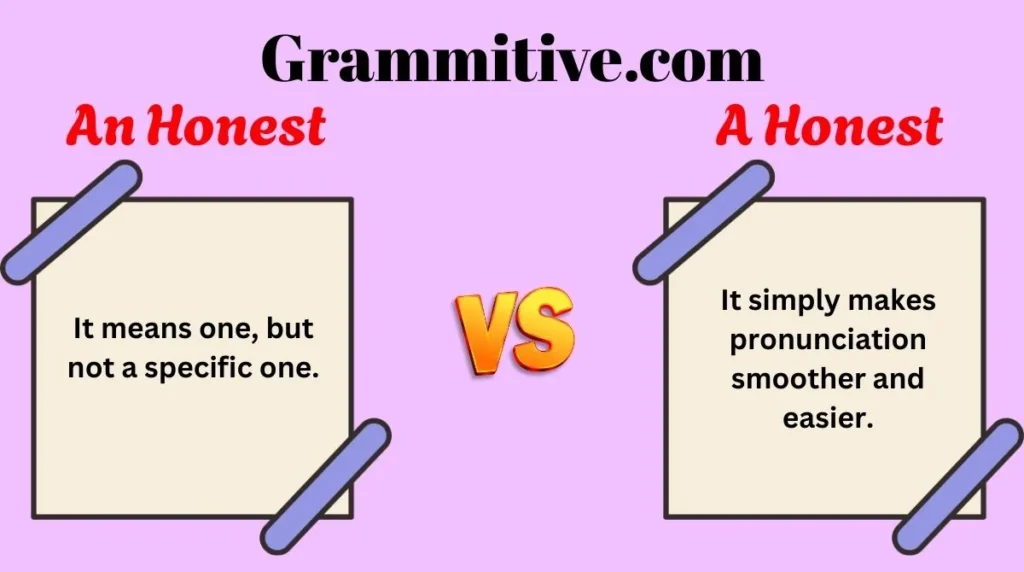
It means one, but not a specific one.
It talks about something general.
For example:
- a dog (any dog)
- a teacher (not a specific teacher)
- a book (one book, but we don’t know which)
When to use it
Use “a” before words that begin with a consonant sound.
Notice the word sound, not letter.
This is very important.
Grammar rule
Use a + consonant sound.
Not consonant letter.
English spelling can trick you. Sound matters more.
Examples
- a boy
- a cat
- a house
- a university (starts with “yu” sound)
- a European trip (sounds like “yu”)
- a one-dollar coin (sounds like “won”)
- a useful tool
- a big idea
Common learner confusion
Students often look only at spelling.
They think:
❌ a honest (because H is consonant)
But the sound is not “h”.
It’s silent.
So the real sound starts with o.
That changes everything.
What Does “An” Mean?
Simple definition
“An” is also an indefinite article.
It has the same meaning as “a”.
It simply makes pronunciation smoother and easier.
It helps our mouth move naturally between sounds.
When to use it
Use “an” before a vowel sound.
Again, focus on sound, not spelling.
Grammar rule
Use an + vowel sound.
Vowel sounds: a, e, i, o, u (and silent h words).
Examples
- an apple
- an egg
- an idea
- an orange
- an umbrella
- an hour (silent h)
- an honest person
- an honor
Common learner confusion
Many students think:
❌ “an” is only for words starting with a, e, i, o, u.
But that is not correct.
Because:
- hour → an hour
- honest → an honest man
- MBA → an MBA (starts with vowel sound “em”)
So again, sound is king.
Difference Between A and An (Detailed)
Now let’s compare them clearly.
Quick comparison table
| Feature | A | An |
|---|---|---|
| Meaning | one, general | one, general |
| Before | consonant sound | vowel sound |
| Focus | sound | sound |
| Example | a cat | an apple |
| With silent H | ❌ | ✅ |
Usage difference
Both words mean the same.
The only difference is pronunciation.
English speakers want sentences to flow smoothly.
Try saying:
❌ a apple
It sounds broken and hard.
Now say:
✅ an apple
Much smoother.
English prefers smooth sounds.
Grammar logic
When two vowel sounds touch, it feels uncomfortable.
Example:
“a apple”
The mouth stops and restarts.
Adding “n” makes it flow:
“an apple”
So “an” is simply for easier speech.
Sentence structure difference
Structure stays the same:
- article + noun
Examples:
- a dog
- an elephant
Nothing else changes.
Meaning comparison
There is zero difference in meaning.
Only pronunciation changes.
Grammar Rules You Must Remember
Rule #1: Use “a” before consonant sounds
- a car
- a pen
- a book
Even if spelling starts with vowel but sound doesn’t:
- a university (yu sound)
Rule #2: Use “an” before vowel sounds
- an apple
- an umbrella
- an elephant
Because these start with vowel sounds.
Rule #3: Silent H = use “an”
If H is silent, treat it like a vowel.
- an honest man
- an hour
- an honor
- an heir
Rule #4: Sound matters more than spelling
Always say the word aloud in your head.
If it sounds like it starts with a vowel → use “an”.
If it sounds like consonant → use “a”.
Common Mistakes Students Make
Why mistakes happen
Most learners follow spelling.
But English pronunciation doesn’t match spelling.
That causes confusion.
Wrong vs correct examples
❌ a honest person
✅ an honest person
❌ an university
✅ a university
❌ a hour
✅ an hour
❌ an useful book
✅ a useful book
Easy correction tips
- Say the word slowly
- Listen to the first sound
- Decide quickly
Your ears are better than your eyes.
Easy Trick to Remember the Difference
Here’s a simple classroom trick.
Ask yourself:
👉 “Can I hear H clearly?”
If yes → use a
- a happy child
- a hard problem
If no (silent H) → use an
- an honest man
- an hour
Another trick:
Cover the first letter and say the word.
“honest” → “onest”
Sounds like vowel.
So use “an”.
Super easy.
Daily Life Examples (Very Important)
These sentences sound like real conversations.
Notice how natural they feel.
- He is an honest man.
- She waited for an hour.
- I saw a dog in the park.
- She bought an umbrella.
- That’s a useful app.
- He gave me an answer.
- I met a university student.
- She told an interesting story.
- We need a helper.
- It was an honor to meet you.
Practice saying them aloud. Your mouth will feel the difference.
Practice Section
Choose the correct option.
- ___ honest teacher
- ___ house
- ___ hour
- ___ useful tool
- ___ apple
Answers
- an
- a
- an
- a
- an
FAQs (SEO Focused)
What is the difference between a and an?
Both mean “one” and are used for general nouns. The only difference is pronunciation. Use “a” before consonant sounds and “an” before vowel sounds.
Why do we say an honest and not a honest?
Because the H in “honest” is silent. The word begins with an “o” sound. That is a vowel sound, so we use “an”.
Can we use a or an in questions?
Yes. Articles work the same way in questions. Example: “Is he an honest man?” or “Do you have a pen?”
Is an more formal than a?
No. Both are normal everyday words. Neither is formal or informal. They are basic grammar articles.
Why do we say a university and not an university?
Because “university” starts with a “yu” sound, which is a consonant sound. So we use “a”.
Are there many silent H words?
Not many, but a few common ones: hour, honest, honor, heir, herb (American English). These usually take “an”.
Final Conclusion
Small grammar points can create big confusion. Articles like a and an look tiny, but they appear in almost every sentence we speak. That’s why learning them correctly is so important.
The key idea is simple. Don’t trust spelling. Trust sound.
If the word begins with a consonant sound, use a.
If it begins with a vowel sound, use an.
And that’s exactly why we say an honest person, not a honest person.
Practice speaking out loud. Listen to native speakers. Read sentences every day. Soon, the choice will feel natural and automatic.
English becomes much easier when you focus on how it sounds, not just how it looks.
Keep practicing. You’re closer than you think.

I am Lucas Bennett, a digital content creator passionate about social media trends and online growth strategies.
I share practical insights and guides to help users better understand and navigate the digital world.