
Many English learners feel confused when they hear sentences like:
“Let’s meet about 5 pm.”
“Let’s meet around 5 pm.”
Both sound correct. Both talk about time. Both feel similar.
So… are they the same?
Not exactly.
Small words like about and around can be tricky because they have many meanings. Sometimes they talk about time.
Sometimes numbers. Sometimes movement. Sometimes topics. And sometimes they simply mean “not exact.”
That’s why learners mix them up.
You might say “Tell me around your problem” or “There are about the park” — and suddenly the sentence sounds strange.
Native speakers don’t always explain why. They just “feel” what sounds right. But you need clear rules, not feelings.
Understanding the difference between these two words helps you:
- speak more naturally
- avoid common grammar mistakes
- sound fluent in daily conversations
- write better English
By the end of this guide, you’ll clearly know when to use each word, how their meanings change, and how to choose the correct one without guessing.
What Does “About” Mean?
Simple meaning
About usually means:
👉 approximately, concerning, or on the topic of
It has a few common uses:
- not exact number/time
- topic or subject
- almost / nearly
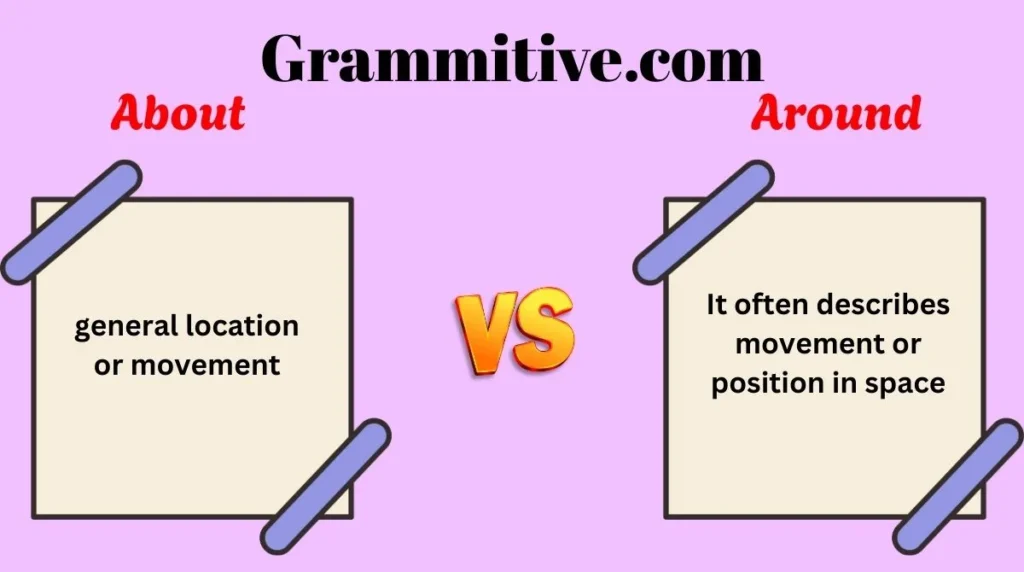
- general location or movement
When to use it
Use about when:
- you are giving an estimate
- you are talking about a topic
- you mean “almost”
- you want to say “around this area” (less physical movement)
Grammar rule
About + number/time/topic
Structure examples:
- about + number
- about + time
- talk/think/learn + about + topic
Examples
- I waited about 10 minutes.
- She has about 50 books.
- We arrived about 8 pm.
- This movie is about friendship.
- Tell me about your family.
- He’s about six feet tall.
- I’m about ready to leave.
- They argued about money.
Common learner confusion
Many students only learn one meaning: “approximately.” But about is also very common for topics.
Wrong: We discussed around the problem.
Correct: We discussed about the problem.
Remember: around cannot normally mean “topic.”
What Does “Around” Mean?
Simple meaning
Around usually means:
👉 in a circle, surrounding, nearby, or approximately
It often describes movement or position in space. But it can also mean “about” when talking about numbers or time.
When to use it
Use around when:
- something moves in a circle
- something is located nearby
- something surrounds something else
- you want to give an approximate number or time
Grammar rule
Around + place/area/number/time
Structure:
- walk/run/drive + around
- around + place
- around + number/time
Examples
- The kids ran around the park.
- We walked around the city.
- There are shops around my house.
- The earth moves around the sun.
- Come around 7 pm.
- It costs around $20.
- He looked around the room.
- I’ll call you around lunchtime.
Common learner confusion
Students sometimes use around when they mean “topic.”
Wrong: This book is around history.
Correct: This book is about history.
Use around for space or movement, not topics.
Difference Between About and Around (Detailed)
Both words can mean approximately, but they are not always interchangeable.
Here’s a clear comparison.
Comparison Table
| Feature | About | Around |
|---|---|---|
| Approximate number | ✅ Yes | ✅ Yes |
| Approximate time | ✅ Yes | ✅ Yes |
| Topic/subject | ✅ Yes | ❌ No |
| Movement in circle | ❌ No | ✅ Yes |
| Nearby location | ❌ Rare | ✅ Yes |
| Surrounding something | ❌ No | ✅ Yes |
| More formal | Slightly | Slightly casual |
Usage difference
About = ideas, topics, estimates
Around = physical space, movement, position, estimates
So:
- talk about a problem
- walk around the problem
Different meanings completely.
Grammar logic
Think like this:
If your sentence is about information, use about.
If your sentence is about space or movement, use around.
For numbers and time, both are okay.
Sentence structure difference
Topic:
- talk about something
- think about something
Movement:
- move around something
- sit around something
You cannot switch them.
Meaning comparison
- about 10 minutes = approximately
- around 10 minutes = approximately
But:
- book about science = correct
- book around science = incorrect
- walk around the park = correct
- walk about the park = old-fashioned or rare
Grammar Rules You Must Remember
Rule #1 – Use “about” for topics
Correct: We talked about the test.
Wrong: We talked around the test.
Rule #2 – Use “around” for physical movement
Correct: She walked around the house.
Wrong: She walked about the house. (sounds unnatural)
Rule #3 – Both work for approximate time or numbers
Correct: about 5 people
Correct: around 5 people
Correct: about 6 pm
Correct: around 6 pm
Rule #4 – Don’t use “around” with “discuss” or “explain”
Correct: Explain about your plan.
Wrong: Explain around your plan.
Common Mistakes Students Make
Why mistakes happen
Because both words sometimes mean “approximately,” learners think they are always the same. But their other meanings are very different.
Mistake 1
❌ This lesson is around grammar.
✅ This lesson is about grammar.
Tip: topic = about
Mistake 2
❌ We drove about the city all day.
✅ We drove around the city all day.
Tip: movement = around
Mistake 3
❌ She placed flowers about the table.
✅ She placed flowers around the table.
Tip: surrounding = around
Mistake 4
❌ I told him around my problem.
✅ I told him about my problem.
Tip: telling information = about
Easy Trick to Remember the Difference
Here’s a simple memory trick many students love.
Think of shapes
Around → circle shape
Picture something going in a circle.
Movement. Space. Position.
If you can draw a circle in your mind, use around.
Walk around the park.
Sit around the fire.
About → brain/thoughts
Think of talking, ideas, or information.
If it’s in your head, use about.
Talk about life.
Think about money.
Circle = around
Ideas = about
Very easy to remember.
Daily Life Examples (Very Important)
These sentences sound natural in real conversations.
- I’ll reach around 9.
- We talked about you yesterday.
- There’s a café around the corner.
- She told me about her trip.
- Come around lunchtime.
- He’s about 30 years old.
- Let’s walk around the lake.
- This movie is about love.
- There were around 100 people at the party.
- I’m worried about my exam.
Notice how topics use about and places use around.
Practice Section
Choose the correct word: about or around
- We learned _____ animals today.
- She looked _____ the room.
- It costs _____ $50.
- Tell me _____ your job.
- Kids were running _____ the garden.
Answers
- about
- around
- about/around (both correct)
- about
- around
FAQs
What is the difference between about and around?
About is mostly for topics or ideas. Around is for movement or position. Both can mean “approximately” for numbers or time.
Can we use around for time?
Yes. You can say “around 6 pm” or “around Monday.” It means “not exactly.”
Is about more formal than around?
Yes, slightly. About sounds a bit more neutral or formal. Around feels casual and conversational.
Can around mean topic?
No. Don’t use around for subjects or discussions. Always use about.
Which is better for numbers?
Both are correct. Native speakers use both naturally: about 20, around 20. No big difference.
Can I use about for movement?
Usually no. Modern English prefers around for movement. “Walk about” sounds old or literary.
Final Conclusion
Small prepositions like these can feel confusing at first. They look similar, sound similar, and sometimes mean the same thing.
But once you notice the pattern, everything becomes clearer.
Use about when you speak about ideas, topics, or information.
Use around when you talk about space, movement, or things that surround something. For time and numbers, you can choose either one.
The best way to master them is practice. Listen to native speakers. Read simple stories. Make your own sentences every day. Soon, choosing the correct word will feel natural.
English becomes easier step by step. Small improvements like this make a big difference.
Keep practicing — you’re doing great.

I am Lucas Bennett, a digital content creator passionate about social media trends and online growth strategies.
I share practical insights and guides to help users better understand and navigate the digital world.