
Many English learners stop for a second when they see a sentence like this:
“She has ___ unique idea.”
Should it be a unique idea or an unique idea?
At first, it looks easy. You may remember the basic rule:
Use a before consonants and an before vowels.
So your brain quickly says, “Unique starts with U. U is a vowel. So it must be an unique.”
Sounds logical, right?
But native speakers say a unique, not an unique. That feels strange and confusing. Students often ask, “Why does the rule not work here?” Some even think English has exceptions with no reason.
The truth is simple and interesting. English articles are based on sound, not just letters. Once you understand this small idea, many problems disappear.
This topic is important because words like unique, university, unit, European, user are very common in daily English. You will hear them in school, work, movies, and conversations.
By the end, you will clearly understand:
- which one is correct
- why it is correct
- how to choose quickly without thinking too much
- and how to avoid common mistakes forever
What Does “A” Mean?
Simple definition
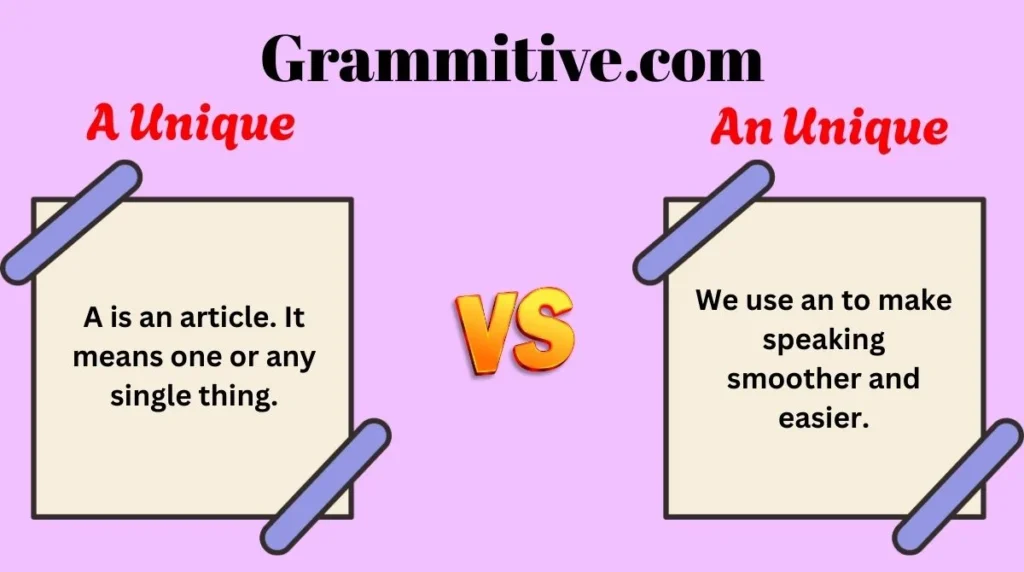
A is an article. It means one or any single thing.
We use a before singular countable nouns.
Examples:
- a book
- a car
- a dog
It talks about something not specific.
When to use it
Use a when:
- the word starts with a consonant sound
- you talk about one thing
- the thing is general or new information
Grammar rule
👉 Use a + consonant sound
Notice: consonant sound, not consonant letter.
Examples
- I bought a pen.
- She has a cat.
- He wants a job.
- We saw a movie.
- That’s a good idea.
- He is a teacher.
- She wore a uniform.
- I need a university form.
Look carefully at the last two:
- a uniform
- a university
Both start with U, but we still use a.
Why? Because the sound is “yoo”, not a vowel sound.
Common learner confusion
Many learners think:
vowel letter = an
consonant letter = a
But English doesn’t work like that.
It follows pronunciation, not spelling.
That’s where mistakes begin.
What Does “An” Mean?
Simple definition
An is also an article. It means the same as a — one or any single thing.
The only difference is pronunciation.
We use an to make speaking smoother and easier.
When to use it
Use an before:
- vowel sounds
- words that start with a, e, i, o, u sounds
Grammar rule
👉 Use an + vowel sound
Again, focus on sound.
Examples
- an apple
- an orange
- an egg
- an umbrella
- an idea
- an hour
- an honest man
- an answer
Notice something interesting:
- hour
- honest
They start with H, but we use an.
Because H is silent.
We say: our, onest
So the sound begins with a vowel.
Common learner confusion
Students often ask:
“Why an hour but a house?”
Because:
- hour → vowel sound
- house → consonant sound (h is pronounced)
So again, the key is sound.
Difference Between A and An (Detailed)
Both words mean the same. The difference is only about pronunciation comfort.
Here’s a clear comparison:
| Feature | A | An |
|---|---|---|
| Meaning | one / any | one / any |
| Used before | consonant sound | vowel sound |
| Example | a car | an apple |
| Purpose | smooth speech | smooth speech |
| Based on | sound | sound |
Usage difference
- a dog
- an elephant
We choose the article that sounds better when speaking.
Try saying:
“a apple”
It sounds hard and strange.
Now say:
“an apple”
Much smoother.
English prefers easy sounds.
Grammar logic
Speech comes first in language history. Writing came later.
So articles developed to help pronunciation flow.
Two vowels together feel difficult.
So an separates them.
Sentence structure difference
Structure is the same:
- a + noun
- an + noun
Only sound changes.
Meaning comparison
No difference in meaning:
- a cat = one cat
- an apple = one apple
So don’t search for deeper meaning. It’s only sound-based.
Grammar Rules You Must Remember
Rule #1 – Use “a” before consonant sounds
Example:
- a dog
- a house
- a teacher
Even if the letter is a vowel, if the sound is consonant, use a.
Example:
- a university (yoo)
Rule #2 – Use “an” before vowel sounds
Example:
- an egg
- an orange
- an umbrella
Even if the letter is consonant, if the sound is vowel, use an.
Example:
- an hour
Rule #3 – Think about pronunciation, not spelling
Say the word out loud.
If it starts with a vowel sound → an
If it starts with a consonant sound → a
Example:
- a European (yoo sound)
Rule #4 – Silent letters matter
If the first letter is silent, ignore it.
Example:
- an honest person
- an heir
A Unique or An Unique? The Real Answer
Now let’s focus on the main question.
The word unique starts with U, but the sound is:
👉 /yoo-NEEK/
It begins with a “y” sound.
“Y” is a consonant sound.
So we must use:
✅ a unique idea
❌ an unique idea
Why?
Because:
- unique → yoo sound
- yoo = consonant sound
- consonant sound → use a
That’s it. No exception. No mystery.
Common Mistakes Students Make
Why mistakes happen
Students usually:
- follow spelling only
- memorize wrong rules
- translate from their first language
- overthink simple grammar
Wrong vs correct examples
❌ an unique design
✅ a unique design
❌ an university
✅ a university
❌ an European country
✅ a European country
❌ a hour
✅ an hour
Easy correction tips
- Say the word out loud
- Listen to the first sound
- Don’t look only at letters
Your ears help more than your eyes.
Easy Trick to Remember the Difference
Here’s a simple trick students love.
The “Yoo Test”
If the word sounds like yoo, always use a.
Examples:
- a unique
- a university
- a uniform
- a user
All start with “yoo”.
So always choose a.
Real-life logic
Try saying:
“an unique”
It feels heavy and awkward.
English prefers smooth sounds.
So your mouth naturally chooses a unique.
Trust your pronunciation.
Daily Life Examples (Very Important)
These sentences sound natural in everyday English.
- She has a unique style.
- That’s a unique name.
- He shared a unique idea in class.
- This shop sells a unique product.
- I met a university student yesterday.
- She wore a uniform to school.
- He is a user of this app.
- That artist has a unique voice.
- We found a unique solution.
- It’s a unique experience.
These are exactly how native speakers talk.
You will never hear “an unique” in real speech.
Practice Section
Choose a or an.
- ___ unique opportunity
- ___ umbrella
- ___ university teacher
- ___ honest mistake
- ___ European city
Answers
- a
- an
- a
- an
- a
FAQs
What is the difference between a and an?
Both mean “one.” The only difference is pronunciation. Use a before consonant sounds and an before vowel sounds.
Is it a unique or an unique?
Always a unique. The word starts with a “yoo” sound, which is a consonant sound.
Can we use an before U?
Sometimes yes. If U sounds like “uh,” use an. Example: an umbrella. If it sounds like “yoo,” use a.
Why do we say an hour but a house?
Because hour has a silent H and starts with a vowel sound. House has a clear H sound.
Is this rule formal or informal?
It’s standard English. Both speaking and writing follow this rule.
How can I remember quickly?
Say the word out loud. If it sounds like it starts with a vowel, use an. If it sounds like a consonant, use a.
Final Conclusion
Small grammar points often create big confusion. The difference between a and an looks tiny, but it affects everyday English.
Words like unique, university, and uniform appear everywhere. Using the wrong article can make your sentence sound unnatural.
The good news is that the rule is simple. Stop looking at the first letter. Listen to the first sound. Your ears will guide you better than spelling.
So remember:
unique → yoo → a unique
Practice speaking these words aloud. Read sentences. Notice how native speakers say them. After some time, choosing the correct article becomes automatic.
Grammar does not have to feel heavy or scary. With small clear rules like this, English becomes friendly and easy.
Keep practicing, and soon you won’t even think twice before saying a unique idea correctly.

I am Lucas Bennett, a digital content creator passionate about social media trends and online growth strategies.
I share practical insights and guides to help users better understand and navigate the digital world.